
Introduction
Cross-border M&A in regulated industries—healthcare, financial services, energy, defense—represents the most complex deal work in 2026. Transactions trigger multi-jurisdictional regulatory approvals, foreign investment screening, and sector-specific compliance requirements that can derail even well-structured deals. More than 50% of CFIUS notice filings now proceed to a second-stage investigation, extending review timelines by months.
The wrong advisory firm creates more than financial risk. It exposes acquirers to enforcement actions, integration failures, and reputational damage in heavily scrutinized sectors. The UK's National Security and Investment Act generated 1,143 notifications in 2024-25, up 25% year-over-year, with median review times reaching 103 statutory working days.
Those timelines demand advisors who treat regulatory navigation as a strategic capability, not an administrative step. This guide covers the top cross-border M&A advisory firms for regulated industries in 2026, what sets them apart, and how to evaluate the right fit for your transaction.
TL;DR
- Generalist M&A firms routinely underestimate regulatory complexity in cross-border deals — sector-specific experience is non-negotiable
- Top firms here were ranked on multi-jurisdictional capability, regulated sector track record, independence, and cross-border deal volume
- Cybersecurity due diligence is now a deal variable: over 70% of dealmakers treat undisclosed breaches as deal breakers
- Match your advisor to your deal size, target geography, and regulatory environment — league table rankings tell only part of the story
- Fee structures and independence vary widely; clarifying both before engagement prevents costly timeline surprises
What Makes Cross-Border M&A in Regulated Industries Uniquely Complex
A domestic healthcare acquisition may require approval from one regulatory body. Cross-border deals are a different category of problem entirely: they trigger simultaneous CFIUS review, foreign investment screening, sector-specific approval from banking or energy regulators, and data privacy compliance across multiple countries — each with different timelines and standards. In calendar year 2024, CFIUS received more than 300 filings, with mitigation measures required in 12% of notices.
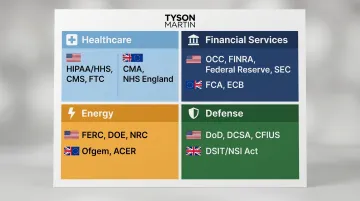
Key regulatory bodies by sector:
- Healthcare: HIPAA (HHS), CMS, FTC (US); CMA, NHS England (UK)
- Financial Services: OCC, FINRA, Federal Reserve, SEC (US); FCA, ECB (UK/EU)
- Energy: FERC, DOE, NRC (US); Ofgem, ACER (UK/EU)
- Defense: DoD, DCSA, CFIUS (US); DSIT via NSI Act (UK)
Regulatory approval is only part of the exposure. The gap most deal teams miss sits in the technology stack.
The Overlooked Risk: Cybersecurity Governance
Most advisor rankings ignore cybersecurity and technology governance due diligence. In regulated industries, the target's security posture, data handling practices, and compliance infrastructure directly affect deal value — particularly when acquiring across jurisdictions with conflicting data sovereignty rules.
Over 70% of dealmakers view undisclosed breaches as deal breakers, and 60% of companies only discover cybersecurity issues after closing. Verizon's acquisition of Yahoo! resulted in a $350 million price reduction after disclosure of major data breaches. A qualified technology risk advisor — with a fractional CISO or board-level technology advisory background — brings the governance structure, decision rights, and escalation thresholds the deal team needs before close, not after.

Top Cross-Border M&A Advisory Firms for Regulated Industries in 2026
These five firms were selected based on:
- Demonstrated cross-border transaction volume
- Documented presence in regulated sectors (healthcare, financial services, energy, defense, or pharma)
- Regulatory navigation capability
- 2025–2026 market recognition
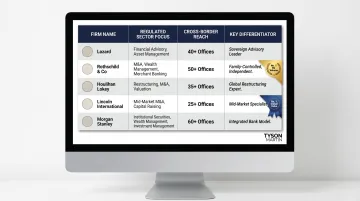
Lazard
Lazard is a global independent financial advisory and asset management firm with deep experience advising corporations, governments, and institutions on complex cross-border M&A. Founded in 1848, the firm operates with more than 3,300 employees across 26 countries, with principal offices in New York, London, and Paris.
The firm's cross-border strength lies in on-the-ground professionals who navigate local capital markets, foreign investment regulatory processes, and sector-specific government relationships. Lazard explicitly positions its Geopolitics Advisory practice to address the regulatory and policy dimensions of cross-border regulated transactions.
The firm's 2025 M&A Review identified "contextual alpha"—navigating geopolitics, regulation, and macroeconomics—as a defining 2026 theme.
Lazard ranked No. 2 in Europe by M&A deal value in 2024 with $71.3 billion in advised transactions, per GlobalData. The firm's independent advisory model eliminates capital markets conflicts that can complicate regulatory review or special committee processes.
| Regulated Sector Focus | Healthcare, financial services, energy, government-adjacent industries |
|---|---|
| Cross-Border Reach | Global offices across Americas, Europe, Middle East, Asia-Pacific (26 countries) |
| Notable Differentiator | Independent advisory model; strong government and regulatory relationship navigation in key markets |
Rothschild & Co
Rothschild & Co brings approximately 1,600 advisors across 47 countries and over 200 years of cross-border deal experience to independent M&A and strategic advisory. In 2025, Euromoney recognized the firm as "World's Best Bank for Independent Advisory"—the most active independent advisory firm globally.
For regulated industry acquirers, Rothschild's independence and breadth of on-the-ground relationships provide intelligence beyond deal mechanics—including regulatory timing, local stakeholder dynamics, and sector-specific deal structuring. The firm completed 351 M&A transactions in 2024, 43% more than its closest independent competitor. Rothschild ranked No. 1 in Europe by M&A deal volume in both 2024 and 2025.
Notable deals include Budapest Airport sale (€4.3 billion), CVC IPO Amsterdam (€2.3 billion), and Ghana sovereign bond restructuring ($13.1 billion)—demonstrating capability in complex, multi-jurisdictional transactions.
| Regulated Sector Focus | Financial services, energy, infrastructure, industrials, healthcare |
|---|---|
| Cross-Border Reach | 47 countries; ranked No. 1 by deal volume in Europe in 2024 and 2025 (GlobalData) |
| Notable Differentiator | Fully independent model with no capital markets conflict; deep relationships across regulatory and government bodies globally |
Houlihan Lokey
Houlihan Lokey is a global investment bank that ranked No. 1 in total global M&A transaction volume in both 2024 and 2025, handling 318 deals in 2025 (GlobalData) and 458 deals (LSEG). The firm employs more than 2,700 professionals worldwide and has particular depth in financial services, healthcare, and restructuring—all heavily regulated sectors.
Houlihan Lokey ranked No. 1 in global healthcare M&A transactions in 2025 with 45 deals—ahead of Rothschild (43), Goldman Sachs (41), and Morgan Stanley (32). The firm's breadth of sector coverage combined with cross-border execution offices across the Americas, Europe, Middle East, and Asia makes it well-suited for mid-market regulated industry deals requiring international reach.
Ten dedicated industry groups cover the sectors where regulatory complexity is highest:
- Business Services, Consumer, Energy, Financial Services, FinTech
- Healthcare, Industrials, Infrastructure, Real Estate, Technology
| Regulated Sector Focus | Healthcare, financial services, insurance, energy, technology |
|---|---|
| Cross-Border Reach | Offices in Americas, Europe, Middle East, and Asia-Pacific |
| Notable Differentiator | Ranked No. 1 globally by M&A deal volume (2024 and 2025); particularly strong in financial services and healthcare transactions |
Lincoln International
Lincoln International is a globally integrated middle-market investment bank with 25-plus offices in 16 countries and over 360 transactions closed in 2024. The firm structures coverage around cross-border industry teams—meaning sector expertise and local execution are combined rather than siloed, critical in regulated industries.
Lincoln is especially relevant for organizations in the $100M–$2B deal range that need genuine cross-border execution rather than a domestic firm with an international brochure. The firm's industry groups—including healthcare, financial services, energy transition, and business services—operate in integrated cross-border teams, reducing handoff risk in multi-jurisdictional regulatory environments.
Lincoln's Energy Transition, Power and Infrastructure Group has advised on over 60 transactions in the past three years, including 21 deals in 2024. The firm also acquired TCG Corporate Finance, a European boutique specializing in technology and digital economy sectors, expanding its regulatory expertise in high-scrutiny industries.
| Regulated Sector Focus | Healthcare, financial services, energy transition, business services, industrials |
|---|---|
| Cross-Border Reach | 25+ offices across 16 countries; integrated cross-border industry teams |
| Notable Differentiator | Middle-market focus with full global execution; cross-border teams organized by sector rather than geography |
Morgan Stanley Investment Banking
Morgan Stanley ranked No. 1 globally by M&A deal value in 2025, advising on approximately $872.7 billion in transactions. As a full-service global investment bank with decades of experience in cross-border and regulated sector transactions, it brings both scale and sector depth.
For large-cap regulated industry transactions in pharma, financial services, and energy, Morgan Stanley's integration of M&A advisory with capital markets, regulatory strategy, and financing gives acquirers a single coordinated team across complex multi-jurisdictional processes.
Euromoney named the firm "The World's Best Investment Bank" in 2025, reflecting consistent performance in high-stakes deals.
Morgan Stanley led the 2025 APAC M&A financial adviser rankings with 63 transactions valued at $59.2 billion and ranked No. 1 in Europe by M&A deal value in 2025 with $109.5 billion. Notable regulated deals include advising Discover Financial Services in its acquisition by Capital One—a major financial services transaction requiring OCC, Federal Reserve, and FDIC approval.
| Regulated Sector Focus | Pharma/life sciences, financial services, energy, technology |
|---|---|
| Cross-Border Reach | Global platform across dozens of countries; led Asia-Pacific M&A in 2024 and 2025 |
| Notable Differentiator | No. 1 globally by deal value in 2025; integrated advisory, financing, and capital markets capability for complex regulated transactions |
Key Factors That Set These Firms Apart in Regulated Cross-Border Deals
Regulatory Navigation Capability
Regulatory navigation is the single most important differentiator. Cross-border regulated industry M&A triggers multiple approval processes:
CFIUS (U.S.): 45-day initial review extending to 90 days for full investigation, with over 50% of notice filings proceeding to second-stage review in 2024. Defense, critical technology, and infrastructure sectors face the most intense scrutiny.
UK NSI Act: Median time from receipt to final order is 103 statutory working days (approximately 136 calendar days), with defense comprising 56% of notifications.
U.S. Antitrust (HSR): In fiscal year 2024, 3.0% of HSR-reported transactions received Second Requests, with 84.7% targeting transactions above $500 million. Banking and insurance represented 9.6% of all reported transactions.
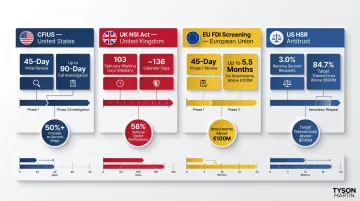
Top firms treat timeline management as core deal execution. That means coordinating regulatory strategy across jurisdictions from the earliest stages: sequencing filings, engaging regulators before formal submission, and running concurrent approval processes to minimize schedule risk.
Independence Matters More in Regulated Deals
Independent advisory firms like Rothschild and Lazard are often preferred in regulated sector deals. Advisors with lending or capital markets relationships to counterparties can create complications in regulatory review or special committee processes.
Three legal frameworks reinforce this preference:
- Delaware law requires special committees of at least two disinterested directors for statutory safe harbor in conflict transactions
- SEC and FINRA regulations mandate disclosure of recent material business relationships between advisors, the company, and the acquirer
- Entire fairness standard — independent financial advisors play a central role in satisfying this test and can shift the burden of proof to plaintiffs
Local Intelligence, Not Just Global Coverage
Genuine on-the-ground regulatory knowledge differs sharply from nominal international office coverage. In regulated industries, local teams that understand a regulator's priorities can be the difference between approval in 60 days and a process that stretches 18 months.
Rothschild's 47-country network, Lazard's government and regulatory relationship navigation, and Lincoln International's integrated cross-border industry teams provide the local intelligence required to manage multi-jurisdictional regulatory processes effectively.
Conclusion
For regulated industries, the right M&A advisory firm must combine global reach with deep, jurisdiction-specific sector knowledge—not just a strong brand name or top league table position. Evaluate advisory firms not only on past deal volume, but on regulatory approval track records, sector team depth, and the firm's ability to manage multi-jurisdictional processes concurrently.
Choosing the right advisory firm is only part of the equation. Cross-border M&A in regulated industries also requires that the acquiring organization's own technology and cybersecurity governance is solid before and during the transaction—from data room security to target IT risk assessment.
Tyson Martin works with boards and executive teams to ensure technology governance and cyber risk posture support M&A transitions rather than complicate them. To discuss how technology oversight fits into your next deal, connect through any of the following:
- tyson.martin@gmail.com
- +1 (802) 430-9200
Frequently Asked Questions
What is a typical advisory fee for an M&A deal?
Most M&A advisors use a retainer-plus-success-fee model. Success fees for mid-market deals typically range from 1–3% of transaction value, varying by deal size and complexity. Regulated industry cross-border deals often command higher fees given multi-jurisdictional approval complexity and extended timelines.
Who is the best M&A advisor for regulated industries?
There is no single best advisor—the right choice depends on deal size, target sector, geography, and regulatory environment. Houlihan Lokey leads by volume and Morgan Stanley by value in 2025, while independent firms like Rothschild and Lazard are often preferred for their lack of advisory conflicts in regulated sector processes.
What makes cross-border M&A in regulated industries more complex than domestic deals?
Cross-border regulated deals add multiple complexity layers beyond standard transactions: multi-jurisdictional regulatory approvals, foreign investment screening, data sovereignty compliance, and local legal differences. Each additional jurisdiction adds time, cost, and execution risk—especially when approval timelines across jurisdictions don't align.
How do cross-border M&A advisors handle multi-jurisdictional regulatory approvals?
Top advisors coordinate regulatory strategy across jurisdictions from the earliest deal stages—managing sequencing, pre-filing engagement with regulators, and concurrent approval processes to minimize timeline risk. Advisors with local regulatory relationships can navigate approval processes more efficiently and avoid deal-breaking surprises.
How should companies prepare their cybersecurity posture before a cross-border M&A deal?
Acquirers should assess both their own and the target's technology governance early in diligence—particularly for regulated industries subject to data privacy laws, breach notification requirements, and sector-specific security mandates. Bringing in a fractional CISO or board-level technology advisor before close can prevent post-close compliance failures and integration delays.