Introduction
Most boards and executive teams have already decided that cybersecurity leadership matters. The harder question is how to structure it — and the answer has real consequences for cost, continuity, and risk exposure. A full-time CISO signals institutional commitment but demands significant investment and a 3–6 month hiring runway. A vCISO delivers expertise on demand, but only works if you know what you need and when.
Neither model is universally right. Organizations face simultaneous pressure from regulators, investors, and customers while managing leadership gaps, compliance deadlines, and threats that don't pause for hiring cycles. The right choice depends on where your organization is — and where it's headed.
TLDR
- A CISO is a full-time executive who owns cybersecurity strategy, team leadership, and board reporting across the organization
- A vCISO provides equivalent strategic leadership on a part-time or project basis — same accountability, lower overhead, no full-time commitment
- Full-time CISOs typically cost $200K–$350K+ annually; vCISOs range from $3K–$15K/month depending on scope
- vCISOs are often the right call for SMBs, organizations in transition, and compliance-driven environments where flexibility matters more than a permanent hire
- During M&A, post-breach recovery, or leadership gaps, a hybrid approach — interim vCISO now, permanent hire later — is often the most pragmatic path
vCISO vs. CISO: Quick Comparison
The core functions — security strategy, risk management, compliance oversight, board reporting — are the same. What differs is structure, cost, and fit for your organization's current stage.
| Dimension | CISO | vCISO |
|---|---|---|
| Engagement Model | In-house, dedicated full-time | Fractional/outsourced, flexible scope |
| Cost Structure | $200K–$350K+ annual salary plus 30–40% benefits | $3K–$15K/month retainer or hourly/project-based |
| Time to Onboard | 3–6 months recruiting + onboarding lag | 1–2 weeks to full operational status |
| Industry Experience | Deep institutional knowledge within one organization | Cross-industry exposure to diverse threat environments and frameworks |
| Integration Depth | Embedded in leadership, continuous presence | Strategic oversight with flexible engagement cadence |
| Scalability | Fixed cost regardless of workload fluctuation | Scales up/down based on audit cycles, incidents, or business needs |
| Best Fit | 100+ employees, regulated industries, large internal teams | SMBs, compliance prep, transitions, interim leadership |
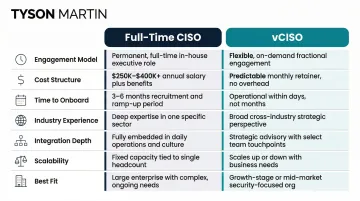
The right choice depends on where your organization sits — not which title sounds more credible.
What is a CISO?
A CISO (Chief Information Security Officer) is a senior executive responsible for the organization's full cybersecurity strategy — not just technical controls, but risk governance, regulatory compliance, incident response leadership, team building, and board-level communication. The CISO is embedded in the organization's decision-making structure, sitting at the intersection of technology, risk, and business strategy.
Core CISO Responsibilities
The modern CISO role has evolved far beyond perimeter defense:
- Setting multi-year security strategy aligned with business objectives and growth plans
- Managing internal security teams including hiring, mentoring, and performance management
- Overseeing vendor risk and third-party security across the supply chain
- Reporting to the board and audit committee on risk posture, compliance status, and incident trends
- Aligning cybersecurity investments with business priorities to enable growth without introducing unacceptable risk
42% of CISOs now report directly to the CEO, up from just 5% in 2023. That shift reflects cybersecurity being treated as an enterprise-wide strategic priority rather than a subset of IT operations.
Title changes track the same trend: 46% of CISOs now hold executive-level titles (including EVP and SVP), up from 33% in 2023.
Use Cases of a Full-Time CISO
The full-time model is most appropriate when:
- The organization exceeds ~100 employees and requires continuous security leadership to manage complexity
- Operating in highly regulated industries such as healthcare, financial services, or government contracting where compliance is continuous
- Managing complex infrastructure at scale with distributed teams, cloud environments, and sensitive data
- Experiencing rapid growth that demands continuous embedded leadership to mature security capabilities alongside business expansion
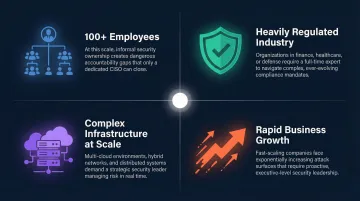
A CISO shapes security culture through sustained presence in leadership meetings, team mentorship, and institutional knowledge that's difficult to replicate through any part-time arrangement.
What is a vCISO?
A vCISO (virtual or fractional CISO) is a senior security leader engaged on a contractual or part-time basis to deliver CISO-level strategy, governance, and advisory without the overhead of a full-time hire. The model is sometimes called "CISO-as-a-Service" and is increasingly common in organizations that need expertise quickly or intermittently.
The Cross-Industry Advantage
vCISOs often bring a broader perspective because they work across multiple clients and industries. That cross-industry exposure means they've already encountered the compliance frameworks, threat patterns, and program failures most internal leaders only read about. They bring pattern recognition — and calibrated judgment — that in-house teams rarely develop at the same pace.
Tyson Martin operates in this capacity — as an interim or fractional CISO and board advisor with hands-on experience at enterprise organizations including AWS and Fortune 100 retailers. He holds active roles in the World Economic Forum's Centre for Cybersecurity, the NRF CISO Executive Committee, and NACD — bringing that enterprise-level depth to organizations that need it without a full-time commitment.
Use Cases of a vCISO
vCISOs are well-suited for:
- Organizations under 100 employees that need senior security leadership but can't justify a full-time executive salary
- Companies preparing for compliance audits such as SOC 2, ISO 27001, or HIPAA certification
- Businesses in transition including leadership changes, post-breach recovery, or M&A due diligence
- Organizations demonstrating security maturity to investors or enterprise customers on accelerated timelines
Interim Leadership Use Case
When a CISO departs or a search is underway (typically 3–6 months), a vCISO can maintain program continuity, guide audits, and keep the board informed without a gap in security leadership. This is particularly valuable given that the average time to fill a cybersecurity vacancy often exceeds six months.
vCISO vs. CISO: Cost Breakdown
The True Cost of a Full-Time CISO
CISO compensation has surged significantly in recent years. The average total compensation for a US CISO reached $1.65M in 2023, and by 2025, it was $1.45M. The top 1% of CISOs earn more than $3.2M in total compensation, roughly 10 times the median.
However, most organizations won't hire a top-percentile CISO. The base salary benchmark typically runs $200K–$350K annually, and total cost of employment — including benefits, bonuses, equity, and recruiting fees — often adds 30–40% on top. Benefit costs for private industry workers account for 29.9% of total employer compensation costs, according to the U.S. Bureau of Labor Statistics.
vCISO Pricing Models
A vCISO offers a more cost-effective alternative:
- Monthly retainers: $3K–$15K depending on hours and scope
- Hourly engagements: $150–$400 per hour
- Project-based fees: Fixed pricing for defined deliverables like compliance readiness or post-breach remediation
Organizations typically spend $36K–$180K annually on vCISO services, saving $200K–$500K+ compared to a full-time CISO. You pay only for what you need.
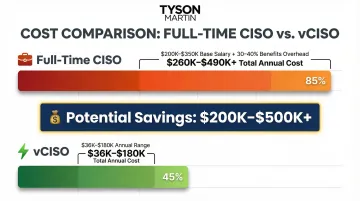
Beyond Salary: The Cost of Vacancy
Hiring a full-time CISO carries costs that don't show up in the salary figure:
- Search timeline: Most CISO searches take 3–6 months, during which security leadership sits vacant
- Onboarding lag: New CISOs typically need 90–180 days to assess the environment and produce a defensible program plan
- Vacancy exposure: Unaddressed risk during the gap draws scrutiny from boards, investors, and regulators
For organizations eventually planning to hire full-time, a vCISO bridges that window — keeping governance intact while the search runs.
Strategic Value: What Each Model Delivers to the Business
Strategic value goes beyond day-to-day operations. Both models must deliver what boards and executive teams actually need: clear risk posture reporting, defensible decisions under pressure, and security that doesn't stall business operations.
CISO Strategic Value: Depth and Permanence
A full-time CISO embeds into the organization's culture, builds long-term security architecture, and becomes a trusted voice in the boardroom over time. Their continuous presence means faster escalation of real incidents and tighter alignment between security priorities and business strategy.
They also develop deep institutional knowledge and mentor internal teams — creating security capabilities that outlast any single initiative.
vCISO Strategic Value: Agility and Cross-Industry Perspective
A vCISO can be onboarded in days, not months. They bring reporting structures and frameworks proven across multiple organizations — and can produce credible, board-ready deliverables from the first engagement. For organizations under compliance pressure or facing a leadership gap, that compressed timeline often determines whether a board briefing happens on schedule or gets delayed by quarters.
The demand for vCISO services is surging, with 79% of MSPs and MSSPs seeing high demand among SMBs.
The Governance Angle: What Boards Actually Need
For boards and audit committees, the most important output of security leadership is not a tool or a policy — it's clarity. Good board-level security reporting includes:
- Trend-based dashboards showing direction of travel, not point-in-time snapshots
- Clear escalation thresholds that define when management escalates to the board
- 90-day priorities with assigned owners and measurable outcomes
Both a CISO and an experienced vCISO can deliver this. The differentiator is whether the leader operates at a governance level — translating risk into decisions — rather than staying in technical reporting mode. While 95% of CISOs deliver regular updates to their boards, only 30% of boards describe their relationship with the CISO as strong and collaborative. Frequency of updates isn't the problem. Clarity and trust are.
The Hybrid Model
That gap in board-CISO trust is one reason some organizations don't choose between the two models — they layer them. A vCISO or fractional CISO working alongside an internal security team (or a less senior in-house leader) provides:
- Surge capacity during audits or active incidents
- An outside perspective that internal teams can't self-generate
- Board-ready reporting without adding a second executive headcount

Which Model Fits Your Organization?
Three variables drive this decision: where your security program stands today, how quickly you need leadership in place, and the complexity of your risk and regulatory environment. Getting that match right determines whether you're buying the right capacity — or paying for the wrong one.
Choose a vCISO When:
- Your organization is under 100 employees
- Preparing for a compliance audit and need expertise within weeks, not months
- Security needs fluctuate (audit season vs. quiet quarters) and paying for idle time isn't defensible
- You need to demonstrate security maturity to investors or enterprise customers quickly
Choose a Full-Time CISO When:
- You have 100+ employees and sustained security leadership demand
- Operating in heavily regulated industries with continuous compliance obligations
- Managing large internal security teams that need direct leadership and mentoring
- The board requires a permanent executive with fiduciary accountability
Choose Interim or Fractional Leadership During Transition When:
- Your CISO just departed and you need continuity during the search
- You're mid-M&A and need immediate security oversight
- You're trying to understand what kind of permanent CISO you actually need before making a permanent hire
- Leadership vacancies of 3+ months routinely expose organizations to audit gaps and delayed incident response — interim coverage prevents that drift
Decision Checklist
Use these questions to pressure-test your current model:
- Has your incident response plan been tested in the last 12 months — or does one exist at all?
- Are you reporting cyber risk to the board in a structured, trend-based way?
- A compliance deadline has been triggered (SOC 2, ISO 27001, customer audit) — do you have the leadership to meet it?
- Can you name your top five cyber risks and who owns each one?
- Does your security leadership capacity actually match your risk profile?
If those questions surface gaps, the right next step is leadership — not another framework. Tyson Martin works with boards and executive teams as an interim or fractional CISO to close those gaps fast, with a 90-day plan, clear decision rights, and measurable outcomes from day one.
Conclusion
The right model is the one that matches your organization's actual stage, risk profile, and governance needs — not the most impressive title. A vCISO can deliver enterprise-grade leadership immediately, while a full-time CISO builds the long-term architecture that maturing organizations eventually need.
Cybersecurity leadership gaps are not just operational risks — they are governance risks that boards, investors, and regulators now scrutinize directly. SEC rules require public companies to disclose material cybersecurity incidents and detail their risk management and governance programs — and that scrutiny is extending to private boards as well.
Whether you hire full-time, engage fractionally, or use a hybrid model, what matters most is that someone with the right expertise and authority has clear ownership of your organization's security posture.
The cost of inaction is steep. The average cost of a data breach in the US has surged to a record $10.22M. Getting the leadership structure right — and getting someone credible in that seat — is where the decision starts.
Frequently Asked Questions
How much does a vCISO cost?
Monthly vCISO retainers typically range from $3K–$15K, hourly rates run $150–$400, and project-based fees vary by scope. Annual vCISO engagements cost $36K–$180K, compared to the $200K–$350K+ annual cost of a full-time CISO (plus 30–40% in benefits and overhead).
What is the role of a vCISO?
A vCISO delivers senior-level security strategy, risk management, compliance oversight, and board reporting on a flexible, fractional basis. The responsibilities mirror those of a full-time CISO — strategy, risk, and board-level communication — adjusted in scope and hours to fit what the organization actually requires.
What is the difference between a vCISO and a CISO?
The primary difference is engagement model: a CISO is a full-time in-house executive, while a vCISO works on a fractional or outsourced basis. Both can own security strategy, but they differ in availability, organizational embedding, and cost structure. A vCISO brings flexibility and cross-industry perspective; a full-time CISO offers deeper organizational embedding and institutional continuity over time.
Why hire a virtual CISO?
Organizations hire vCISOs for cost efficiency, faster onboarding (1-2 weeks vs. 3-6 months for a full-time hire), cross-industry expertise, and flexibility during transitions or audits — including access to senior security leadership that a smaller organization couldn't otherwise justify.
What is the difference between a vCIO and a CISO?
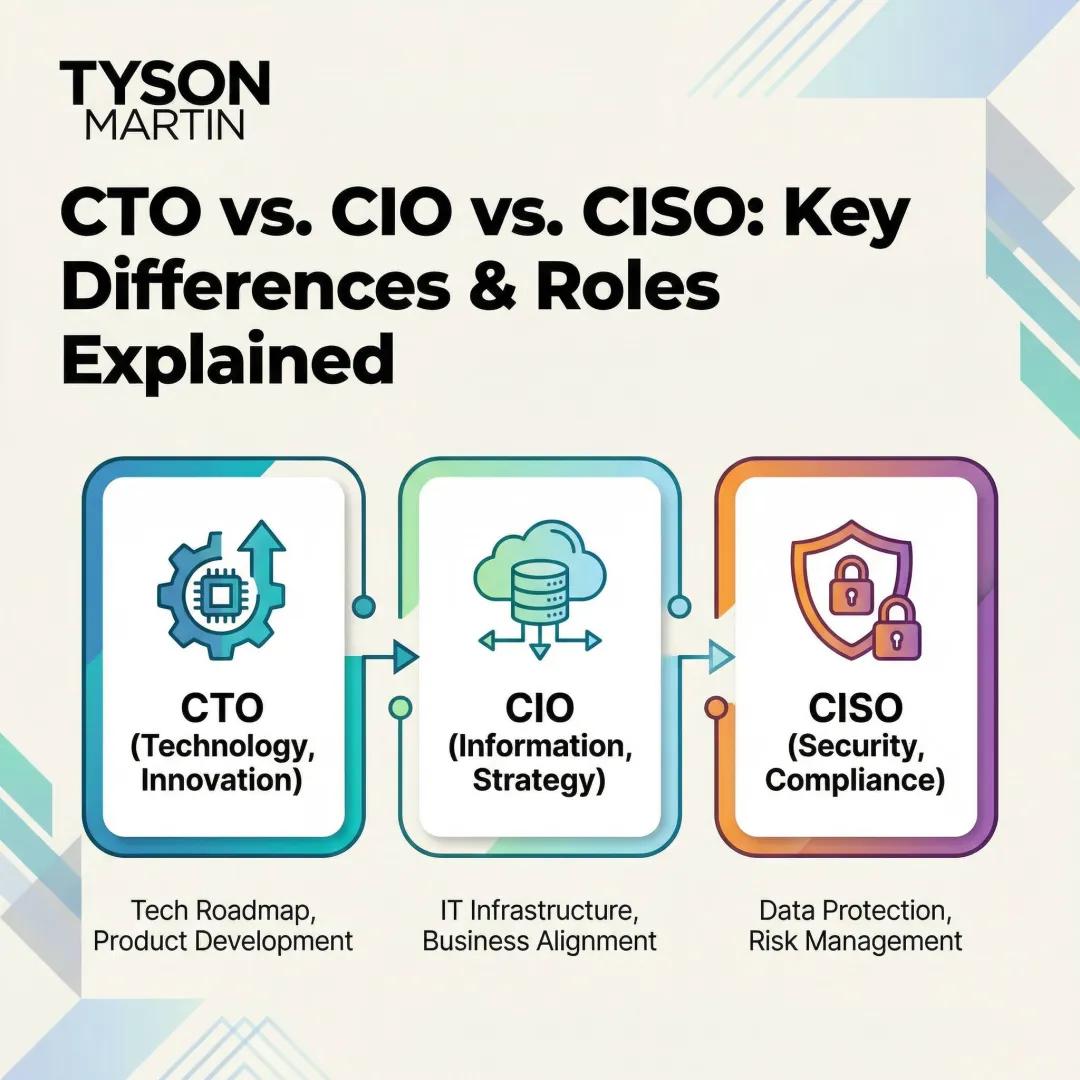
A vCIO (virtual Chief Information Officer) focuses on overall IT strategy and operations, while a CISO — whether full-time or virtual — is specifically responsible for cybersecurity strategy, risk governance, and information security. The roles complement each other but carry separate mandates.
Does ISO 27001 require a CISO?
ISO 27001 does not mandate the CISO title, but it does require designated information security leadership and clear ownership of the ISMS. A qualified vCISO can fulfill this requirement and guide certification, provided accountability remains with the organization.