Introduction
Boards and executive teams are caught between mounting pressure and constrained resources: cyber threats are outpacing internal capabilities, regulators want demonstrable oversight, and hiring budgets haven't kept pace with either. At the same time, executive searches for full-time CISOs, CIOs, or Chief Digital Officers can drag on for three to four months—leaving organizations exposed during leadership transitions, M&A activity, or compliance deadlines.
Fractional C-level technology executives are no longer a cost-saving workaround. They represent a deliberate leadership strategy — one that brings senior expertise and board-ready governance online in weeks, not months, without the overhead of a permanent hire. The model works especially well for organizations in transition, regulated industries facing audit scrutiny, and boards that need clarity fast.
What follows is a breakdown of the specific, measurable benefits — and why more boards are treating fractional executive leadership as a standing governance strategy rather than a gap-fill.
TL;DR
- Fractional executives provide enterprise-level leadership on a part-time basis at 30–70% lower cost than full-time hires
- Deploy in days, not months — built for leadership gaps, M&A transitions, and hard compliance deadlines
- Deliver board-ready governance that meets SEC disclosure requirements and audit committee scrutiny
- When leadership is in flux or regulators are watching, this model closes the gap without a lengthy search
What Is a Fractional C-Level Technology Executive?
A fractional CISO, CIO, or Chief Digital Officer works with an organization on a part-time, interim, or project basis—embedded as an active executive team member, not an outside consultant. They hold decision authority, report to boards, sign risk acceptance memos, and drive execution. The distinction matters: fractional executives own outcomes, whereas consultants advise from the sidelines.
Organizations typically engage fractional technology leaders when they need senior expertise but cannot justify or sustain full-time headcount. Common scenarios include:
- Leadership gaps: Sudden departures, extended searches, or succession planning failures
- Regulated industries: Financial services, healthcare, and retail facing audit or compliance deadlines
- Growth-stage companies: Organizations scaling quickly but not yet ready for permanent C-suite expansion
- Post-incident recovery: Rebuilding governance and board confidence after a breach or near-miss
The governance infrastructure they build—decision rights, escalation thresholds, board reporting cadence—stays in place after the engagement ends.
Key Benefits of Hiring Fractional C-Level Technology Executives
The benefits below are grounded in operational and governance impact—not abstract claims. They are most visible in cost structure, decision speed, risk posture, and board confidence.
Enterprise-Grade Expertise Without the Full-Time Price Tag
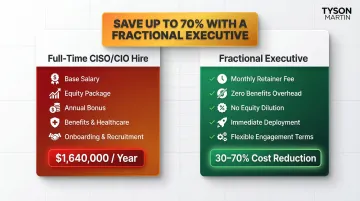
Hiring a full-time CISO costs an average of $1.64 million annually when you account for base salary, equity, bonus, benefits, and onboarding time. For CIOs, total compensation ranges from $250,000 to over $700,000 depending on industry and organizational complexity. Many mid-market companies cannot sustain this level of executive overhead—and don't need daily, hands-on leadership for every technology function.
Fractional engagements solve this cost-value asymmetry. Industry data shows fractional arrangements typically cost 30% to 70% less than fully-loaded executive compensation, while delivering equivalent strategic governance.
The organization accesses a professional who has already led security transformations, managed regulatory audits, and reported to boards at enterprise scale—without building that experience internally. Savings on executive overhead can be redirected toward technology modernization, staff training, or incident response infrastructure.
A fractional executive who has operated across multiple industries and regulatory environments also brings pattern recognition that a newly hired permanent leader may take years to develop—having navigated the same compliance cycles, board escalations, and governance breakdowns before.
KPIs impacted:
- Executive labor cost as percentage of IT/security budget
- Time-to-productivity for leadership coverage
- Leadership cost per strategic initiative delivered
When this benefit matters most:
- Pre-revenue or growth-stage organizations
- Companies needing CISO or CIO capability for compliance readiness (SOC 2, HIPAA, PCI-DSS) but unable to justify full-time hire
- Businesses with board-level reporting obligations and no current technology executive
Speed and Flexibility During Technology Transitions
Leadership gaps from departures, M&A integrations, cloud migrations, post-incident recovery, and regulatory readiness cycles all require immediate, experienced technology leadership—not a 90-day hiring process. Executive searches for C-suite roles typically take 60 to 120 days, and during that window, critical decisions stall, incidents escalate without clear authority, and boards receive incomplete information.
Forty-one percent of organizations lack a succession plan for the CISO role, creating a dangerous vacuum when unexpected departures occur. Fractional technology executives deploy in days or weeks, skip the ramp-up curve that affects permanent hires, and begin stabilizing governance, assessing risk, and reporting to boards almost immediately.
Organizations can also scale the engagement up during high-stakes periods—regulatory audits, incident response, system overhauls—and scale back once stability is established, without severance risk or long-term commitment. That kind of adaptability is simply not possible with a permanent hire.
KPIs impacted:
- Time-to-leadership coverage
- Incident response readiness
- Board meeting preparation cycle
- Compliance deadline adherence
When this benefit matters most:
- Organizations experiencing sudden CISO or CIO departures
- Companies entering M&A due diligence
- Businesses managing first-time regulatory audits or cybersecurity certification processes
Governance Clarity and Cyber Risk Oversight Boards Can Trust
A fractional technology executive translates complex risk into clear, defensible language that boards, audit committees, and general counsel can act on. Rather than technical briefings that generate more questions than answers, a well-structured fractional engagement produces stable dashboards showing risk trends, clear escalation paths for incidents, and defined decision rights between management and the board.
Board exposure to technology risk is now a governance liability. The SEC's 2023 cybersecurity disclosure rules require companies to describe board oversight processes and disclose material incidents within four business days. Regulators actively enforce these rules—recent charges against Ashford Inc. and Intercontinental Exchange demonstrate the financial and reputational cost of inadequate oversight.
Despite heightened regulatory scrutiny, only 30% of directors rate their board's ability to oversee a cyber crisis highly. A fractional CISO or CIO who has advised boards at enterprise scale closes this governance gap faster than internal promotion or traditional hiring.
Operational impact:
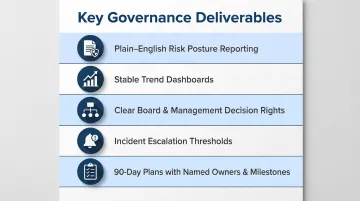
The right fractional executive delivers outcomes aligned with how effective governance actually works:
- Plain-English risk posture reporting showing what changed since the last briefing
- Stable dashboards that show trend, not trivia
- Clear decisions for the board and clear delegation for management
- Decision rights and escalation thresholds that hold in real incidents
- 90-day plans with named owners and measurable outcomes
KPIs impacted:
- Board confidence in technology risk reporting
- Time between incident detection and escalation
- Regulatory examination readiness
- Number of unresolved high-risk findings across audit cycles
When this benefit matters most:
- Regulated industries (financial services, healthcare, retail)
- Organizations with audit or risk committees lacking technology fluency
- Companies that have experienced a breach or near-miss and need credible governance restoration
What Happens When Technology Leadership Is Missing or Ignored
Without a senior technology executive, decisions get made by default rather than design. Escalation paths for incidents remain unclear, and boards receive either too much technical noise or too little actionable information—both of which create liability.
Operational consequences include:
- Security incidents spiral beyond their initial scope when no one holds clear decision authority in the first critical hours
- Compliance failures surface during audits rather than being caught proactively — remediation costs routinely exceed what a fractional engagement would have cost
- Shadow IT and fragile systems multiply when no executive owns governance, slowing modernization and expanding the attack surface
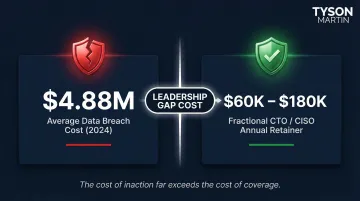
The global average cost of a data breach reached $4.88 million in 2024, directly tied to the time it takes to identify and contain the breach. The longer organizations operate without senior technology leadership during a transition, the more expensive and disruptive the eventual fix becomes. The damage is financial, reputational, and increasingly regulatory.
How to Get the Most Value from a Fractional Technology Executive
Fractional technology executives deliver the most value when the engagement is structured rather than open-ended. Define outcomes upfront — typically a 90-day plan with named owners and measurable milestones. Set reporting cadences before the first board meeting, and document escalation thresholds before they are needed.
Fractional executives perform best when treated as embedded members of the executive team — not outside consultants — with access to relevant systems, stakeholders, and board materials. Surface-level engagement produces surface-level results.
Value compounds over time when engagement insights are acted on:
- Maintain a risk dashboard that tracks trends and gets reviewed on a fixed cadence
- Stress-test decision rights against real scenarios, not just policy documents
- Refine the governance model continuously as the organization grows and risk exposure shifts
Organizations that act on these insights accumulate institutional knowledge that outlasts the engagement itself — and that's what makes fractional leadership worth the investment.
Conclusion
Fractional C-level technology executives represent a deliberate leadership model — one that puts experienced, board-ready oversight in place at a cost and commitment level that matches how most organizations actually operate.
The benefits compound over time. Cost savings emerge early, but governance clarity and risk reduction deepen as the engagement matures — when reporting stabilizes, decision rights hold under pressure, and priorities translate into execution that the board can actually inspect.
As regulatory scrutiny and cyber risk both escalate, the question for most organizations is no longer whether to have experienced technology leadership — it's whether the leadership model they've chosen gives them clear oversight, credible reporting, and decisions they can defend.
Frequently Asked Questions
What are the benefits of fractional leadership?
Fractional leadership delivers cost-efficient access to senior expertise, faster deployment during transitions, and flexible engagement structures that scale with organizational needs. In technology roles, these benefits extend to board-level governance and cyber risk oversight that satisfies regulatory expectations.
How much do fractional executives get paid?
Fractional technology executives are typically compensated on a retainer or hourly/day-rate basis, with monthly retainers ranging from $5,000 to $15,000+ depending on organizational complexity and scope. This represents 30-70% savings compared to full-time executive compensation packages.
When should a company hire a fractional technology executive?
Common triggers include executive departure, M&A activity, a regulatory audit or cybersecurity incident, or a board that needs credible technology oversight but lacks the budget or timeline for a permanent hire. Organizations in rapid growth or leadership transition benefit most.
What is the difference between a fractional CISO and a consultant?
A fractional CISO holds accountability for outcomes, makes binding decisions, signs risk acceptance memos, and reports to the board as a member of the executive team. A consultant advises from outside without the same accountability or embedded operational role.
What types of organizations benefit most from fractional technology executives?
Regulated industries (financial services, healthcare, retail), organizations in leadership transition, and digital-native businesses scaling quickly are the most common fit. Companies with audit or risk committees that need credible, board-ready technology reporting are especially well-served by this model.
How long does a typical fractional technology executive engagement last?
Engagements range from focused 90-day stabilization periods to ongoing retainer arrangements spanning multiple quarters or years. Duration should be tied to specific outcomes rather than a fixed calendar, with clear milestones and decision points built in from the start.