What are the cyber security strategies?
Effective cybersecurity strategies include risk-based prioritization aligned with business objectives, clear governance frameworks defining decision rights and escalation paths, continuous monitoring with stable metrics showing trends, incident response readiness with tested playbooks, third-party risk management prioritizing vendors by business impact, identity and access controls following least-privilege principles, board-ready reporting translating technical risks into business impacts, and regular assessments identifying gaps with actionable remediation plans. Tyson Martin implements these strategies through executable 90-day roadmaps with measurable outcomes.
What is the difference between a Virtual CISO and a Fractional CISO?
Both Virtual CISO (vCISO) and Fractional CISO services provide part-time cybersecurity leadership without full-time commitment. The terms are often used interchangeably. Tyson Martin's approach emphasizes clear scope definition, 30-60-90 day deliverables with measurable KPIs, board-ready reporting, and strategic guidance while delegating operational tasks to internal teams. The engagement is tailored to your organization's size, pace, and risk profile, providing senior-level decision support, governance frameworks, and executable roadmaps that reduce risk without slowing business operations.
How long does it take to develop a cybersecurity roadmap?
A comprehensive cybersecurity roadmap typically takes 30-90 days depending on organizational complexity and existing documentation. Tyson Martin's approach begins with rapid risk triage to identify critical exposures, followed by stakeholder interviews and control assessments. The deliverable includes prioritized initiatives with clear owners, due dates, and measurable outcomes organized into 30-60-90 day phases. Unlike generic frameworks, the roadmap reflects your specific business context, regulatory requirements, and risk appetite, providing executable priorities rather than theoretical recommendations.
What should a board-level cybersecurity briefing include?
Board-level cybersecurity briefings should translate technical risks into business impacts using plain-English reporting. Essential elements include current risk posture with changes since last briefing, top three risks with potential business impact, incident readiness status with tested response capabilities, vendor and third-party risk concentrations, compliance status with regulatory requirements, key metrics showing trends not trivia, and recommended decisions with clear options. Tyson Martin uses a one-page template format enabling boards to make informed decisions about downtime tolerance, disclosure obligations, and resource allocation.
How do you measure cybersecurity program effectiveness?
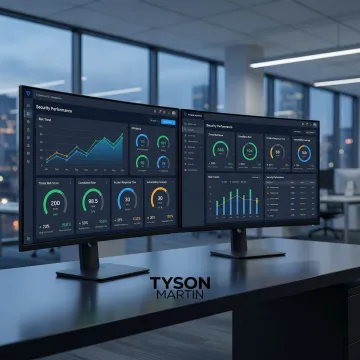
Cybersecurity program effectiveness is measured through stable KPIs that show trend rather than trivia. Key metrics include time-to-detect and time-to-respond for incidents, percentage of critical assets with updated recovery plans, vendor risk scores for business-critical suppliers, percentage of users with least-privilege access, percentage of systems meeting patching SLAs, incident response drill completion rates, and audit finding closure rates. Tyson Martin implements dashboards with ownership assignments, exception tracking, and board-ready reporting that demonstrates risk reduction over time with measurable outcomes.
What qualifications should a cybersecurity consultant have?
Qualified cybersecurity consultants should hold relevant certifications like CISSP, demonstrate enterprise-level experience leading security programs, understand board governance and risk management frameworks, possess strong communication skills to translate technical risks into business language, maintain current knowledge of threat landscapes and emerging risks, and have proven track records with measurable outcomes. Tyson Martin holds CISSP certification, led security at AWS and Fortune 100 retailers, serves on the NRF CISO Executive Committee and World Economic Forum Centre for Cybersecurity, and delivers board-ready reporting with executable roadmaps.
How often should we conduct cybersecurity assessments?
Organizations should conduct comprehensive cybersecurity assessments annually at minimum, with targeted assessments triggered by significant changes like new systems, mergers and acquisitions, major incidents, regulatory changes, or leadership transitions. Continuous monitoring between formal assessments tracks key metrics and exception trends. Tyson Martin's assessment approach includes board-ready findings, ownership assignments for remediation, clear risk rankings by business impact, and 90-day action plans with measurable outcomes, ensuring assessments drive actionable improvements rather than generating reports that sit on shelves.
What is included in incident response readiness services?
Incident response readiness services include creating or updating incident response plans with clear roles and escalation paths, conducting tabletop exercises simulating realistic scenarios to test team coordination, validating backup and restore capabilities with actual recovery tests, establishing communication protocols for internal teams and external stakeholders, documenting evidence preservation procedures for potential investigations, defining decision thresholds for containment versus recovery actions, and creating board notification templates. Tyson Martin ensures plans are actionable during actual incidents with tested playbooks, not theoretical documents.