Introduction
Most leadership teams build advisory boards the same way they make introductions at conferences — informally, opportunistically, and without defined criteria. The result is predictable: advisors who disengage, guidance that misses the mark, and governance structures that fail when tested.
Over 50% of advisory board engagements in emerging businesses are postponed due to lack of planning and resources, according to the Advisory Board Centre. Without clear criteria, structured outreach, and defined expectations, advisory boards produce disengaged members and misaligned guidance.
The stakes are higher now in regulated industries. Board-level oversight of technology, risk, and compliance faces direct scrutiny under the SEC cybersecurity disclosure rules adopted in July 2023. An underperforming advisory board is no longer just a missed opportunity — it's a governance liability.
This guide covers exactly how to define your needs, source and evaluate candidates, structure the offer, and onboard advisors who will engage substantively from day one.
TL;DR
- Define skill gaps and governance blind spots before approaching candidates
- Source through professional networks, peer referrals, industry associations, and targeted platforms beyond your immediate contacts
- Personalize outreach with clear value propositions; generic requests don't attract serious advisors
- Evaluate on alignment, availability, and character alongside credentials
- Structure engagement from day one with written charter, defined expectations, and clear compensation
What to Define Before You Start Recruiting
Before you contact a single candidate, conduct an honest audit of your leadership team's capability gaps. Use a skills matrix or gap analysis to identify missing expertise across areas such as:
- Market expansion and growth strategy
- Regulatory navigation and compliance
- Cybersecurity and technology governance
- Financial strategy and capital markets
- Specific industry domain knowledge
Clarify your advisory board's primary purpose. Will it provide strategic guidance, credibility signaling, network access, domain expertise, or governance oversight? Different purposes require fundamentally different candidate profiles. Chasing a single all-purpose advisor almost always ends in a poor fit.
Once purpose is clear, translate it into concrete criteria that screen candidates before the first conversation.
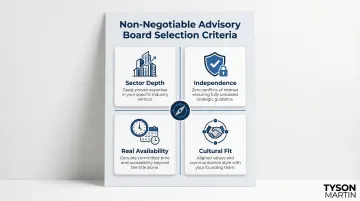
Define non-negotiable selection criteria before outreach begins:
- Sector depth: Relevant experience in your specific industry or growth stage
- Independence: No material conflicts of interest with your business or competitors
- Real availability: Genuine time commitment, not just stated intent
- Cultural fit: Alignment with your leadership style and decision-making norms
How to Recruit Advisory Board Members: Step-by-Step
Step 1: Map Your Skill Gaps and Define Ideal Profiles
Review your existing leadership team's capabilities and identify where external expertise would create the most strategic leverage. Be specific : "We need someone who has scaled cybersecurity governance in a regulated retail environment" is far more useful than "We need a tech advisor."
For each gap identified, define a brief profile covering:
- Required depth of experience
- Relevant industry or functional background
- Expected engagement type (strategic sounding board vs. active domain advisor vs. credibility signal)
Spencer Stuart research found that only 3.9% of new S&P 500 directors in 2021 had experience leading cybersecurity, IT, software engineering, or data functions — demonstrating how specific expertise gaps require targeted recruitment strategies.
Step 2: Source Candidates Through Targeted Channels
Start with your professional network — trusted peers, investors, and current advisors are often the fastest path to qualified referrals. Board-level roles are rarely filled through open searches. When your immediate network runs thin, broaden your sourcing:
- Industry associations like NACD for board-level roles
- LinkedIn advanced search filtered by function, industry, and experience
- Sector-specific communities in your vertical
- Advisory matching platforms such as Bolster that connect organizations with experienced part-time advisors and board members
Step 3: Personalize Your Outreach
Avoid generic "would you consider joining our advisory board?" messages. Research the candidate's background, identify a specific reason their experience addresses a defined need, and open the conversation around their expertise — not your ask.
LinkedIn data shows personalized InMails perform approximately 15% better than bulk messages, with messages under 400 characters receiving 22% higher response rates.
Reference the candidate's specific work, publications, affiliations, or past governance roles. Make the mutual value explicit: what they gain from the relationship, not just what you're asking for.
Step 4: Structure Evaluation Conversations Before Making Any Offer
Conduct an informal but structured conversation covering:
- Your organization's strategic direction
- The advisory role's scope and expectations
- What success looks like
- What the candidate is looking for in an advisory role
This surfaces motivation, availability, and character alignment before any offer is made. Ask questions that reveal how the candidate thinks about governance, oversight, and risk — particularly if your organization operates in a regulated industry.
Credentials matter, but engagement style matters more. An advisor with deep expertise who communicates poorly or engages infrequently will underdeliver. Assess fit for how your leadership team actually operates.
Key Factors That Determine Who Belongs on Your Advisory Board
Expertise Alignment Over Prestige
The most important criterion is whether the candidate's experience directly addresses a gap on your leadership team — not whether their title or brand looks impressive on a bio page.
Distinguish genuine domain depth from surface-level familiarity by asking for specific, applied examples during conversations. Request they describe a complex decision they guided, the factors they weighed, and the outcome. Generic answers reveal limited depth.
Diversity of Perspective
An advisory board composed of advisors with near-identical backgrounds produces near-identical thinking. Intentionally build in diversity across industry background, functional specialty, and lived experience.
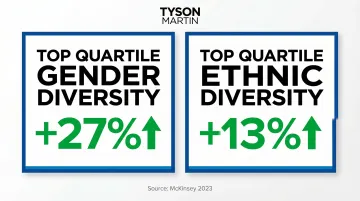
McKinsey's 2023 research found companies in the top quartile for board gender diversity are 27% more likely to outperform financially, with ethnic diversity adding another 13% performance advantage. Those cognitive gains — a broader knowledge base, less groupthink — apply directly to advisory governance.
Network Relevance and Genuine Access
Some advisors bring valuable relationships with customers, regulators, investors, or peer executives. Evaluate whether those relationships are active and relevant to your specific challenges — not just impressive on paper.
Ask each candidate directly:
- Which contacts in your network map to our current challenges?
- When did you last engage them on something substantive?
- Would you be comfortable making introductions when appropriate?
Authentic Availability
Many high-profile candidates will say yes and then be consistently absent. During evaluation conversations, probe specifically for bandwidth:
- What does their current advisory portfolio look like?
- How do they engage between formal meetings?
- What does "available" actually mean to them?
Research shows 33% of private company directors spend 51-100 hours per year on board work, with 21% spending over 100 hours annually. Advisory boards typically require fewer hours — but an absent advisor is worse than no advisor at all.
Engaging and Onboarding Advisory Board Candidates
Structure the formal offer with a written advisory board charter that defines:
- The board's purpose and scope
- Individual member expectations
- Meeting cadence
- Term length (typically 1-3 years with renewal options)
- Compensation structure (equity, retainer, honorarium, or expense coverage)
A clear charter protects both parties and prevents expectation gaps before they form.
Compensation Ranges by Organization Type
Private Companies: Median annual retainer for fiduciary board members is $38,800, with per-meeting fees averaging $2,500. Advisory board compensation typically runs 65-75% of fiduciary board rates — approximately $25,000-$29,000 annually.
Early-Stage Startups: Median equity grants range from 0.05% at Series A to 0.21% at pre-seed stage, typically vesting over two years with monthly vesting and minimal or no cliff.
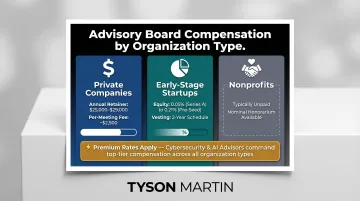
Nonprofits: Nonprofit advisory roles are typically unpaid or carry a nominal honorarium.
Cybersecurity, AI, and digital governance advisors may command higher rates given current demand and limited supply of qualified candidates.
Onboarding: Set Advisors Up to Contribute
Provide orientation on:
- The organization's mission and strategic priorities
- Relevant financials and governance documents
- Key leadership introductions
- Current organizational challenges and strategic initiatives
Advisors who are well-oriented contribute faster and more confidently than those dropped into meetings with no context.
Set engagement norms upfront so advisors know what to expect between meetings:
- When and how they'll be contacted outside scheduled sessions
- Which decisions warrant escalation to the advisory board
- How their input will be used — and by whom
Most organizations skip this last part. Closing the loop on their advice is one of the simplest retention levers available.
Common Mistakes When Recruiting Advisory Board Members
Recruiting for Brand Recognition Over Fit
Impressive resumes and big names generate credibility optics but rarely generate engagement. Advisors recruited for their brand rather than their relevance to your actual challenges will disengage quickly.
Detect this risk during evaluation by asking for specific examples: "Walk me through a situation where you advised on a challenge similar to what we're facing. What was your approach? What worked and what didn't?"
Skipping Formal Documentation
Organizations that recruit advisors on a handshake with no written charter, no defined expectations, and no clear compensation terms create confusion, misalignment, and awkward exits. Formalizing the relationship from day one builds the foundation for a functional governance relationship — not bureaucratic overhead, but basic clarity that protects both parties.
Failing to Act on Advisory Input
A board that consistently provides guidance that goes unacknowledged or un-actioned will disengage. Closing the loop is the retention strategy most boards skip. Structure communications that show advisors their input is being considered, acted on, or set aside — with reasons given.
When Urgent Governance Gaps Can't Wait: If a critical expertise gap — particularly in cybersecurity oversight, technology risk, or digital governance — cannot wait for the 3-6 month advisory board recruitment cycle, a fractional board advisor or interim executive can provide structured, board-level guidance immediately while a longer-term advisory bench is built.
For boards navigating technology risk, regulatory scrutiny, or leadership transition, a fractional CISO or Chief Digital Officer such as Tyson Martin can step in with clear oversight and executable priorities from day one.
Frequently Asked Questions
How much money do advisory board members make?
Compensation ranges from unpaid (early-stage or nonprofit) to equity-based (startup: 0.05%-0.21% of fully diluted shares) to cash retainers and meeting fees (enterprise: $25,000-$40,000 annually). Specialist advisors in high-demand areas like cybersecurity or AI typically command higher compensation.
How to find advisory board members?
Start with professional networks and peer referrals, then expand to LinkedIn advanced search, industry associations like NACD, and targeted advisory placement platforms.
How to select an advisory board?
Define skill gaps first, then evaluate candidates on domain relevance, genuine availability, cultural fit, and diversity of perspective rather than credentials or name recognition alone. Conduct structured evaluation conversations before making any offer.
Who should be responsible for selecting advisory board members?
Selection typically falls to the CEO or founder, ideally in consultation with the existing board or governance committee. The selection process should involve multiple stakeholders to avoid bias toward the CEO's personal network and ensure diverse perspectives.
Who should be on my advisory board?
Ideal advisory boards include a mix of domain experts (filling specific leadership gaps), industry insiders (close to your market and customers), a strategic generalist with scaling experience, and advisors with technology, cybersecurity, and board oversight expertise.
How to recruit advisory board members?
Define your gaps, source through professional networks and targeted channels, personalize outreach with a specific value proposition, and evaluate candidates through structured conversations. Formalize every engagement with a written charter that sets expectations, time commitments, and scope upfront.