The appeal is straightforward: senior expertise, lower cost, faster time to impact. But results vary widely. Many companies stumble not because the model is flawed, but because the engagement wasn't set up properly. Scope drifts, internal sponsors vanish, and decision rights remain ambiguous. When those conditions exist, even experienced fractional leaders produce mediocre outcomes.
This article explains when fractional executive leadership is the right fit, what must be in place before engagement begins, the specific steps that make it work, and the mistakes that most commonly cause it to fail.
TL;DR
- Fractional executives hold real decision-making authority as part-time embedded leaders—not consultants or temporary replacements
- Success requires defined scope, strong internal sponsorship, and genuine organizational readiness
- Track measurable 90-day outcomes with clear decision rights built into the leadership rhythm from day one
- Common failures include shifting mandates, ambiguous reporting lines, and treating fractionals as advisors rather than operators
- For CISO, CIO, and CDO roles, the fractional model delivers immediate governance and risk reduction without full-time search delays
What Is Fractional Executive Leadership?
A fractional executive is a seasoned professional who works part-time—typically 10 to 20 hours per week—as an embedded member of the leadership team with decision-making authority. The key distinction from consultants comes down to execution: consultants recommend, fractionals execute — a difference worth understanding before you hire. Unlike interim executives who step in full-time during temporary vacancies, fractional leaders operate on a sustained part-time basis.
The most common fractional roles are CFO (appearing in 18.8% of fractional leaders' profiles) and CMO (14.3%). CISO, CTO, and Chief Digital Officer roles are also being filled fractionally at a growing rate, particularly in regulated industries facing governance pressure.
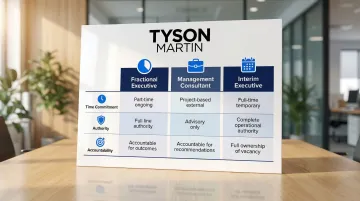
Key role distinctions:
| Role Type | Time Commitment | Decision Authority | Accountability |
|---|---|---|---|
| Fractional Executive | Part-time, ongoing | Full line authority within mandate | Business outcomes and execution |
| Management Consultant | Project-based, external | Advisory only | Quality of recommendations |
| Interim Executive | Full-time, temporary (3-12 months) | Complete operational authority | Covers vacancy, full ownership |
The fractional model is most prevalent in companies with $3M–$100M in revenue, though the range shifts with industry and growth stage. Adoption is moving fastest in regulated sectors, driven by SEC cybersecurity disclosure requirements and increasing audit committee scrutiny of technology risk.
When Fractional Executive Leadership Is the Right Fit
The fractional model is not universally appropriate. It works when there is specific strategic need, limited internal capacity, and defined scope. It breaks down when organizations need full-time presence or haven't defined the problem they're solving.
Where Fractional Leadership Excels
Leadership gaps during transitions are the most common use case. Organizations deploy fractional executives during CEO transitions, M&A integration, incident response, and digital modernization. When a company needs a function stood up for the first time—first CISO, first CDO, first CFO—a fractional leader can establish policy, own the roadmap, and hire toward the role without waiting for a permanent placement.
Bounded, time-limited work is an equally strong fit. Regulatory readiness, board reporting overhauls, and technology transformation projects benefit from fractional leadership because the scope is defined and outcomes are measurable. When speed matters more than permanent presence, the model holds.
For technology and cyber roles specifically, fractional CISO and CIO engagements are particularly well-suited to regulated industries. Deloitte notes that virtual CISOs provide executive-level accountability aligned with NIS2, DORA, GDPR, ISO 27001, and NIST CSF requirements. In healthcare and finance, fractional CISOs ensure compliance with HIPAA, PCI DSS, and SOX while providing direct cybersecurity input to boards.
Where the Model Becomes Inefficient or Risky
The fractional model fails when goals shift week to week or when no internal owner exists to integrate the executive's work into daily operations. Some functions simply require full-time presence. Expecting a fractional leader to manage a 24/7 SOC or own daily operational reviews creates a structural mismatch from day one—the model wasn't designed for that kind of load.
What to Have in Place Before Engaging a Fractional Executive
Preparation directly determines how fast the engagement creates value. Organizations that skip this step consume the executive's limited hours on context-building rather than execution.
Define the Problem in Concrete Terms
A fractional executive needs to know not just the role, but the specific outcomes expected in the first 30, 60, and 90 days. Vague mandates like "improve our security posture" or "fix our operations" rarely translate into traction. Deloitte research shows that ambiguity surrounding who is responsible for making a decision is a primary cause of delay, increasing the risk that decisions fall through the cracks entirely.
Assess Cultural Readiness
The existing team must understand that the fractional executive holds a peer-level role — not an outside consultant position. Leadership must be willing to operate on a part-time cadence rather than expecting daily presence. When staff have competing priorities or resist the arrangement, the executive spends limited hours managing internal friction instead of driving the mandate.
Check These Boxes Before Day One
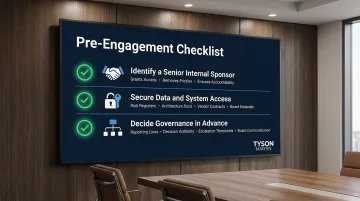
Three operational items should be resolved before the engagement starts — not during it:
- Identify a senior internal sponsor who grants access, removes organizational friction, and holds the executive accountable. Without an empowered champion, the fractional leader hits walls and spends time on politics rather than progress.
- Secure data and system access from day one. For technology and cyber roles, this means immediate access to risk registers, architecture documentation, vendor contracts, and relevant board or audit committee materials. Waiting weeks for permissions wastes the engagement window before substantive work begins.
- Decide governance in advance. Clarify reporting lines, decision authority versus escalation thresholds, and how the executive will communicate progress to the board or leadership team. Without this clarity, the engagement stalls at recommendations with no one accountable for action.
How to Make Fractional Executive Leadership Work: Step-by-Step
Even with the right conditions in place, execution determines whether the engagement delivers. The following steps separate high-performing fractional arrangements from ones that plateau or collapse.
Step 1: Define Scope and Mandate Before Day One
Document a specific, written mandate covering the three to five problems the fractional executive is brought in to solve. Avoid listing responsibilities; list outcomes instead.
Example: Not "oversee cybersecurity" but "establish board-ready risk reporting, resolve the three open audit findings, and build a 12-month security roadmap."
Agree on what "done" looks like for the initial engagement term—usually six to twelve months—and tie success to stable, inspectable metrics rather than activity-based outputs.
Step 2: Establish Decision Rights and Escalation Thresholds
Clarify what the fractional executive can decide independently, what requires consultation, and what must be escalated to the CEO, board, or audit committee. In governance-heavy roles like CISO or CIO, ambiguity here is one of the most common causes of stalled engagements.
Define escalation thresholds explicitly:
- Under what conditions does the fractional executive go directly to the board or audit committee?
- What constitutes an incident requiring immediate response?
- Who is notified and how?
This structure is what allows fractional engagements in regulated industries to hold up under real pressure.
Step 3: Integrate the Executive Into the Right Conversations
Ensure the fractional executive is included in all conversations relevant to their mandate:
- Leadership meetings and board briefings
- Vendor reviews and contract decisions
- Cross-functional discussions that touch their scope
Being excluded from key conversations is a structural failure that prevents the executive from delivering on the mandate.
Brief the broader team from day one. Internal staff, direct reports, and peer executives should understand the fractional's role, authority, and mandate to avoid confusion, resistance, or duplication of effort.
Step 4: Track Progress Against Agreed Outcomes
Review progress against the stated 90-day plan at regular intervals—not through activity reports but through movement on specific outcomes. Maintain a visible, stable dashboard showing trend over time, not one-off metrics that spike or dip without context.
At each review interval, answer two questions: Is the engagement moving the needle on the outcomes defined in Step 1? If not, what's blocking progress and who owns the fix?

Common Mistakes That Derail Fractional Executive Engagements
Shifting the Mandate Mid-Engagement
The most common failure pattern occurs when organizational priorities change after the fractional executive is already in place. What was a focused mandate becomes a catch-all role. Fast Company identifies "shifting goals" as a critical failure mode, noting that when mandates constantly change—one week growth, next week rebrand—fractional leaders are forced to build systems to handle ambiguity rather than executing on either priority.
When scope expands without adjusting hours, budget, or timelines, the executive either burns out or produces mediocre results across too many fronts.
Treating the Fractional Executive as Advisory
Organizations often bring in a fractional leader but then route all significant decisions through internal staff or back to the CEO, cutting off the executive's ability to act. The result is consultant-quality output — analysis, recommendations, documents — without the execution that justifies the engagement.
Failing to Build Internal Alignment Before the Engagement Starts
When the team working with the fractional executive has any of the following, most of their limited hours go to managing politics rather than driving the mandate:
- No clear understanding of how the fractional model works
- Resentment toward the outside presence
- Competing internal priorities that predate the engagement
Cultural readiness is an operational prerequisite, not a soft consideration to address later.
Frequently Asked Questions
What is fractional executive leadership?
Fractional executive leadership is an arrangement where a senior professional works part-time (typically 10–20 hours per week) as an embedded member of the leadership team with real decision-making authority, rather than as an outside consultant or temporary full-time replacement. Engagements typically run six to eighteen months.
What is the difference between a CEO and a fractional CEO?
A CEO is a full-time permanent leader accountable for the entire organization. A fractional CEO provides strategic leadership part-time—typically during transitions, growth phases, or while a permanent hire is being sourced—with limited hours but equivalent authority within their defined mandate.
What is the difference between a fractional executive and a consultant?
Consultants provide recommendations and deliverables from outside the organization. Fractional executives are embedded in the leadership team, attend internal meetings, hold decision-making authority, and drive execution. The distinction is accountability and integration, not just hours worked.
How long does a fractional executive engagement typically last?
Most engagements run six to eighteen months initially, with many extending beyond that. Engagement length should match the scope of the mandate, not be open-ended.
How much do fractional executives get paid?
Compensation varies by role, experience, and market. Retainer-based pricing is most common, typically ranging from $5,000–$20,000+ per month depending on hours and seniority. Hourly rates for specialized roles generally run $150–$500+.
How do you measure the success of a fractional executive engagement?
Success should be measured against the specific outcomes defined at the outset—not activity metrics. That means progress against a 90-day plan, movement on named priorities, and governance structures put in place. Trend-based dashboards are more reliable indicators than one-off snapshots.