TLDR
- Financial institutions face compounding regulatory, cyber, and digital pressures that demand senior leadership — without the cost or delay of a full-time hire
- Fractional leadership in financial institutions now extends well beyond the CFO — CISO, CIO, and Chief Digital Officer engagements are increasingly common
- Key benefits include deployment in days rather than a drawn-out search, 60–70% cost savings, and cross-industry expertise that improves decision-making
- The right moment to engage: leadership gaps, M&A activity, regulatory exams, or a technology modernization push that needs an owner
What Fractional Operations Means for Financial Institutions
The fractional model brings experienced executives who work part-time or on contract, splitting their capacity across multiple organizations and delivering C-suite-level leadership without full-time salary and benefits overhead.
For regulated institutions, the bar is higher. Financial services require executives who understand compliance obligations, board reporting standards, and operational risk — not generalists who can navigate those requirements only from the outside.
Fractional vs. Interim Engagements:
Financial institutions often confuse these two models, but they serve different purposes:
- Fractional: Part-time, ongoing engagement — the executive is embedded across multiple clients and provides continuous strategic guidance without occupying a full seat
- Interim: Full-time, temporary coverage at a single institution — typically deployed during a leadership gap, regulatory event, or transition period
The right choice depends on the situation. A community bank navigating a standing compliance program needs the recurring structure of fractional. A credit union that just lost its CISO to a competitor needs the full availability of interim.
Why Financial Institutions Are Turning to This Model Now
The Talent Gap at the Executive Level
33% of cybersecurity organizations report they cannot afford to hire staff with the skills they need, creating a critical shortage at the C-suite level. For financial institutions competing for technology, cybersecurity, and operations leaders, the challenge is even more acute. Traditional executive searches drag on for months while risks compound daily.
Regulatory Complexity Driver
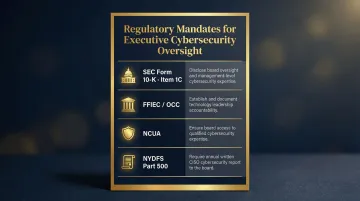
Post-2023 regulatory updates have raised the floor on what counts as adequate executive oversight. Multiple frameworks now explicitly require documented, senior-level expertise — not just policy documents:
- SEC Form 10-K Item 1C requires documented board oversight and management-level cybersecurity expertise
- FFIEC guidance and OCC operational risk expectations set higher bars for technology leadership accountability
- NCUA mandates that boards provide management access to cybersecurity expertise and adequate budget commensurate with risk profiles
- NYDFS Part 500 requires CISOs to report in writing at least annually to the board or equivalent governing body
Institutions that lack this expertise internally are now exposed — not just operationally, but on paper.
Digital Transformation Pressure
Community banks, credit unions, and regional institutions face mounting pressure to modernize core systems, launch digital products, and compete with fintechs. Most smaller institutions don't have that strategic technology leadership on staff.
The market isn't waiting. Fintechs, neobanks, and digital banks captured 44% of new checking account openings in 2024, forcing traditional institutions to accelerate or lose ground.
Yet 60% of bank technology projects missed their schedules over the past 18 months due to integration issues and vendor delays. Fractional CIOs and CDOs provide the strategic direction these projects need — without locking institutions into permanent hires they may not need once the initiative lands.
Cost-Structure Reality
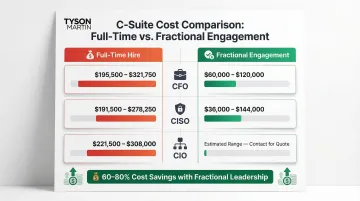
Full-time C-suite executives cost financial institutions $250,000 to $565,000+ annually when factoring salary, benefits, bonuses, and recruiting fees:
- CFO: $195,500 to $321,750 annually
- CISO: $191,500 to $278,250 annually
- CIO: $221,500 to $308,000 annually
Fractional CFO engagements average $60,000 to $120,000 annually, while fractional CISOs deliver comparable strategic oversight for $36,000 to $144,000 annually — a 60-80% cost saving. For community banks and credit unions operating on tight margins, this budget math is driving rapid adoption.
Organizational Transitions Factor
Community bank mergers accelerated to 127 in 2025, alongside 157 credit union mergers, driving complex system integrations. M&A activity, leadership succession gaps, and post-incident recovery periods create windows where institutions need senior leadership fast — and fractional models can deploy in days, not the months a traditional executive search requires.
The Fractional Roles That Matter Most for Financial Institutions
Fractional CFO
Core responsibilities in financial services:
- Financial strategy and capital planning
- Regulatory capital reporting and ALCO preparation
- Investor and board communication
- Budgeting, forecasting, and financial risk management
Best fit for:
- Community banks under $500 million in assets
- Credit unions managing growth or merger integration
- Growth-stage fintechs requiring board-ready financial reporting
Fractional COO
Financial strategy only creates value when operations can execute. Fractional COOs drive process efficiency, manage vendor relationships, oversee technology implementations, and maintain continuity during transitions. They're especially valuable during core banking migrations or merger integration, where operational discipline determines success or failure.
Key deliverables:
- Vendor relationship governance
- Process optimization and efficiency improvement
- Technology implementation oversight
- Business continuity and operational resilience
Fractional CISO
Cybersecurity leadership has become a baseline regulatory expectation for financial institutions. From September 2023 through May 2024, credit unions reported 892 cyber incidents, with 73% involving third parties. Yet 99% of community and mid-size banks rely on third-party vendors to support cybersecurity needs, creating governance gaps that regulators scrutinize closely.
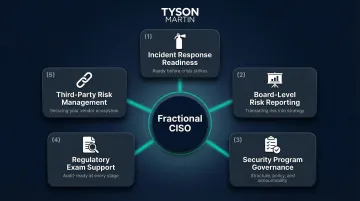
What a fractional CISO delivers:
- Incident response readiness and tabletop exercises
- Board-level reporting and risk communication
- Security program governance aligned to FFIEC, OCC, and SEC expectations
- Regulatory exam support and remediation planning
- Third-party risk management frameworks
A fractional CISO like Tyson Martin connects technical risk directly to board communication, translating complex exposures into defensible decisions without slowing operations. His approach emphasizes clear decision rights, governance structures that hold under real pressure, and board-ready reporting that satisfies regulatory scrutiny.
Fractional CIO
Most community banks and credit unions don't have the internal bandwidth to manage a core conversion, cloud migration, and ongoing technology risk simultaneously. A fractional CIO provides strategic oversight for exactly these moments — core conversions typically run 9 to 24 months for mid-sized institutions, and they require someone accountable for vendor selection, architecture decisions, and risk governance throughout.
Strategic focus areas:
- Core banking modernization and vendor selection
- Cloud migration strategy and governance
- Data and analytics infrastructure
- Technology risk management and resilience planning
Fractional CDO (Chief Digital Officer)
Member expectations around digital banking have shifted faster than most institution roadmaps. A fractional CDO brings digital transformation leadership — mobile banking, customer experience, product strategy — without the cost or long-term commitment of a permanent executive hire. For institutions running a two- to three-year digital initiative, that tradeoff often makes more financial sense.
Key responsibilities:
- Digital product strategy and roadmap
- Mobile banking and customer experience design
- Fintech partnership evaluation
- Digital channel optimization
What Financial Institutions Actually Gain
Cost Efficiency Without Capability Sacrifice
Fractional CFOs cost 60-70% less than full-time CFOs, while fractional CISOs deliver comparable strategic output at 70-80% savings. This frees budget for execution rather than headcount — allowing institutions to invest in technology, training, and controls rather than just salaries.
For a community bank with $300 million in assets, the difference between a $250,000 full-time CISO and a $60,000 fractional engagement is $190,000 annually — enough to fund critical security tools, third-party assessments, and training programs.
Cross-Industry Perspective as a Strategic Asset
Fractional executives who have worked across industries bring security frameworks and governance models that rarely surface when leadership has only ever worked inside one institution. Tyson Martin's experience spanning AWS, enterprise retail, and financial services delivers frameworks for cloud security, digital transformation risk, and operational resilience that accelerate decision-making and reduce trial-and-error costs.
For financial institutions, that cross-sector exposure often means skipping the learning curve entirely — arriving with tested approaches rather than building them from scratch.
Faster Time-to-Value Than Traditional Hiring
Fractional executives onboard in days rather than months, arrive with transferable frameworks, and can begin producing results — audits, governance structures, strategic plans — almost immediately. When the board or regulators are waiting, this speed matters.
Typical fractional CISO first 30 days:
- Risk snapshot and baseline assessment
- Incident decision authority confirmation
- Backup and recovery validation
- Board reporting framework establishment
- 90-day risk reduction roadmap
Cleaner Governance and Board Communication
Experienced fractional executives typically sharpen board reporting from the start. Where internally-promoted leaders often default to technical summaries, a seasoned fractional executive delivers briefings boards can act on. That means:
- Translating technical exposures into clear business impact
- Setting material thresholds so boards know what warrants escalation
- Defining decision rights upfront — before an incident forces the question
When and How to Engage a Fractional Executive in Financial Services
Four Clearest Trigger Moments for Engagement
1. Executive Departure or Leave of AbsenceAn unexpected CFO, CISO, or CIO exit creates a leadership vacuum. Fractional coverage provides immediate stability while the institution runs a full executive search.
2. M&A Due Diligence or Post-Merger IntegrationMergers surface technology integration gaps, governance misalignment, and operational risk fast. Experienced fractional leadership keeps those issues from compounding while permanent teams are still being assembled.
3. Regulatory Exam Preparation or Post-Exam RemediationWhen an exam is imminent or findings need remediation, fractional executives deliver the governance frameworks, documentation, and board reporting that regulators expect to see.
4. Specific Technology or Transformation InitiativeCore banking migrations, cloud adoption, and digital transformation programs often exceed what internal teams can lead alone. A fractional executive provides the strategic direction without a permanent hire.
What to Look for When Evaluating a Fractional Candidate
For regulated institutions, the right fractional executive brings:
- Regulatory literacy: Direct familiarity with FFIEC, OCC, SEC, and NCUA guidance — not a general compliance background
- Board-level communication: Can translate technical risk into decisions a board can act on, not just reports they can file
- Comparable institution experience: Prior work inside banks, credit unions, or similarly regulated environments
- Governance that holds under pressure: Frameworks built to survive incidents, exams, and audits — not just routine compliance cycles
How to Structure the Engagement for Success
Define scope and decision rights upfront:
- Clarify authority boundaries between fractional executive and permanent team
- Establish escalation protocols for incidents and regulatory matters
- Document reporting relationships and board communication cadence
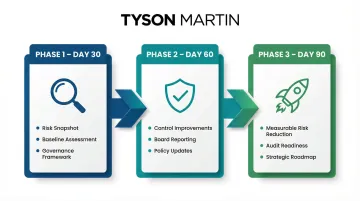
Set 30/60/90-day milestones:
- 30 days: Risk snapshot, baseline assessment, governance framework
- 60 days: Control improvements, board reporting, policy updates
- 90 days: Measurable risk reduction, audit readiness, strategic roadmap
Clarify escalation path:Ambiguity during an incident or exam is expensive. Before engagement begins, define:
- Who holds decision authority under pressure
- When and how the board gets notified
- How communication flows between fractional leadership and permanent executives
Frequently Asked Questions
How much should I pay a fractional CFO?
Fractional CFO engagements typically range from $3,000 to $10,000 monthly retainers or $175 to $450 hourly rates, with most financial institutions paying $5,000 to $7,500 monthly. Cost varies based on institution size, scope complexity, and engagement frequency.
Is a fractional CFO worth it?
For community banks, credit unions, and growth-stage fintechs, the ROI is typically strong when engagements are scoped correctly. At $60,000 to $120,000 annually, a fractional CFO costs less than a quarter of a full-time hire at $250,000+, while closing the strategic leadership gap that most community institutions can't afford to leave open.
What is the difference between a fractional and an interim executive?
Fractional means ongoing part-time work across multiple clients simultaneously, while interim means temporary full-time coverage at a single institution. Financial institutions use both depending on whether they need sustained part-time strategic guidance or full-time coverage during a leadership gap.
What fractional executive roles are most critical for a financial institution?
The CFO, COO, CISO, CIO, and CDO are most frequently engaged on a fractional basis in financial services. Regulatory pressure and rising cyber exposure have pushed the CISO and CIO roles to the front of the queue — boards are now accountable for both, and the gap shows up fast in examinations.
When should a bank or credit union bring in a fractional CISO?
Key triggers include a cybersecurity incident or near-miss, a regulatory exam with technology or security findings, a digital transformation initiative creating new attack surface, or the absence of dedicated security leadership at the executive level. Given that 73% of credit union cyber incidents involve third parties, governance gaps create material risk that fractional CISOs address immediately.