Introduction
Technology and cyber risk have moved from IT concerns to board-level governance priorities. Yet most organizations lack the full-time executive leadership needed to manage both without operational disruption. The challenge is structural: 90% of non-executive directors lack confidence in cybersecurity value, according to Gartner's Board of Directors Survey, while regulatory frameworks like the SEC's 2023 cybersecurity disclosure rules now require board-level accountability for technology governance.
That gap — between board accountability requirements and the absence of full-time executive leadership — is where fractional CIO advisory operates. It delivers governance clarity and strategic stability to leadership teams navigating a complex risk environment. This article unpacks what fractional CIO advisory actually delivers: for boards, executive teams, and organizations where technology decisions carry real business consequences.
TL;DR
- Fractional CIOs deliver strategic IT and cyber risk leadership without the $270,000-$320,000 annual cost of full-time hires
- Key benefits include board-level governance, access to enterprise-grade expertise, and leadership continuity during M&A or transitions
- Organizations lacking this function face misaligned IT investments, unresolved cyber risk exposure, and leadership teams diverted into day-to-day technical escalations
- Structured engagements with clear decision rights, consistent reporting rhythms, and measurable outcomes outperform ad hoc consultation
- Particularly valuable for regulated industries, organizations in transition, and boards requiring credible technology oversight
What Is a Fractional CIO?
A fractional CIO is an experienced technology executive who works with an organization on a part-time or engagement basis, delivering strategic IT leadership and cyber risk oversight without the overhead of a permanent executive hire. Unlike full-time roles that require 6-9 month hiring cycles and $270,000-$320,000 in annual employer costs, fractional engagements can be activated within days at $6,000-$22,000 per month—representing 40-60% cost savings.
The scope extends well beyond IT management. Fractional CIO services include:
- Technology governance frameworks
- Risk reporting to boards
- Vendor strategy and third-party risk management
- Compliance readiness (SOC 2, ISO 27001, NYDFS Part 500)
- Executive-level decision support
The Core Value Proposition
When no senior technology voice sits at the strategy table, boards receive technical updates without strategic framing—and governance gaps emerge that regulators and auditors scrutinize. A fractional CIO closes that gap directly, bringing executive-level oversight without the ambiguity that comes from an unfilled seat.
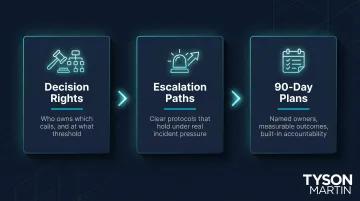
Practitioners like Tyson Martin—board advisors and fractional CIOs with backgrounds spanning AWS and enterprise retail—structure engagements around three core elements:
- Decision rights: who owns which calls, and at what threshold
- Escalation paths: clear protocols that hold under real incident pressure
- 90-day plans: named owners, measurable outcomes, and built-in accountability
Key Advantages of Fractional CIO Advisory
Each advantage below maps to a measurable governance or operational outcome — most acute where technology decisions intersect with risk, compliance, or growth pressure.
Board-Level Technology and Cyber Risk Governance
One of the most significant and underserved advantages is the ability to build a credible, structured bridge between technical teams and board-level oversight. This ensures risk is reported in terms the board can act on.
How fractional CIOs create this advantage:
- Establish clear escalation thresholds (defining what constitutes a material incident requiring board notification)
- Standardize risk reporting formats (plain-English dashboards showing trend, not trivia)
- Translate technical complexity into defensible decisions
- Replace noise with stable dashboards that show what changed since last briefing
Why this is an advantage:
Without a senior technology voice, boards either over-rely on IT staff reports that lack strategic framing, or disengage entirely. Both create governance gaps. Research confirms the scale: Only 10% of non-executive directors express strong confidence in their cybersecurity oversight, yet 71% want their enterprises to take more technology risk to counter global volatility.
That disconnect creates real fiduciary exposure. The SEC's 2023 cybersecurity rules require public companies to disclose material incidents within 4 business days and maintain documented governance structures. The SolarWinds enforcement — the first time a CISO was charged with fraud — confirmed that regulators will hold individual leaders accountable, not just organizations.
KPIs impacted:
- Board risk reporting accuracy and clarity
- Audit findings related to technology governance
- Escalation response time
- Incident decision latency
When this advantage matters most:
- Regulated industries (healthcare, financial services, retail)
- Organizations preparing for M&A or exit
- Boards with active audit or risk committee oversight requirements
Cost-Effective Access to Senior Technology Leadership
Hiring a full-time CIO carries significant cost. The U.S. Bureau of Labor Statistics reports mean annual wages of $180,720, but true employer cost—including benefits—reaches $270,000-$320,000 per year. Add executive recruiting fees (20-30% of first-year salary, or $40,000-$70,000), and the investment compounds before the hire even starts.
How the fractional model creates this advantage:
Engagements are scoped to actual leadership needs:
- Light engagement (1-2 days/week): $6,000-$10,000/month
- Standard engagement (2-3 days/week): $10,000-$16,000/month
- Senior engagement (3+ days/week): $16,000-$22,000/month
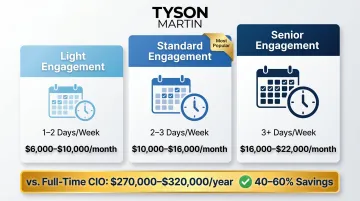
This delivers focused, measurable outcomes rather than standing overhead. A standard fractional engagement at $12,000/month ($144,000/year) represents 53% savings versus full-time cost.
Why this is an advantage:
Organizations consistently underestimate the cost of technology leadership gaps. McKinsey research across 5,400+ IT projects found that large projects run 45% over budget, deliver 56% less value than predicted, and 17% threaten company existence. Most of those failures trace back to the same gap: no one at the table with authority to push back on bad assumptions before money moves.
A fractional CIO who has seen these failure modes before — at scale, across industries — brings the pattern recognition to catch misaligned vendor contracts, unvetted security investments, and reactive spending decisions before they compound.
KPIs impacted:
- IT budget variance
- Cost of misaligned technology investments
- Time-to-decision on strategic technology initiatives
When this advantage matters most:
- Organizations with IT teams in place but lacking senior strategic leadership
- Companies exiting a period of interim or delegated leadership
- Mid-market firms needing enterprise-grade expertise without enterprise-scale cost
Leadership Continuity During Organizational Transitions
Transitions—leadership departure, merger, acquisition, post-incident recovery, digital modernization—create technology governance vacuums. If unmanaged, these expose organizations to operational and reputational risk.
How fractional CIO advisory provides continuity:
- Step in with executable priorities (clear 90-day plans with owners and due dates)
- Stabilize existing teams (clarify decision rights and escalation paths)
- Maintain clear communication to executive leadership and the board
- Prevent reactive firefighting that compounds during disruption
Why this is an advantage:
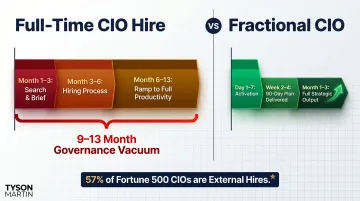
CIO hiring takes 3-6 months from brief to start, plus 6-7 months to reach full productivity. That's a 9-13 month governance vacuum — and technology decisions carry their highest risk precisely during that window.
57% of Fortune 500 CIOs are external hires — the highest external hire rate in the C-suite — meaning most organizations can't rely on promoting from within. A fractional CIO who can assess the situation quickly and deliver a 90-day plan with clear owners keeps the organization moving rather than stalled waiting for a permanent hire to ramp up.
KPIs impacted:
- Time-to-stability post-transition
- Reduction in unplanned technology incidents
- Vendor and project continuity rates
- Executive team confidence in technology direction
When this advantage matters most:
- M&A activity (due diligence, integration planning)
- Post-incident recovery (stabilizing security programs after breaches)
- New executive onboarding (bridging technology oversight during CEO/COO transitions)
- Regulatory or compliance-driven modernization
What Happens When Fractional CIO Advisory Is Missing or Ignored
Organizations without senior technology leadership bridging IT and executive decision-making face predictable consequences:
Technology risk is reported inconsistently or not at all. Boards lack visibility to ask the right questions or exercise meaningful oversight. When directors receive technical updates without strategic context, they cannot distinguish signal from noise.
IT spending becomes reactive and misaligned. Budgets expand without clear prioritization. Vendors fill the void left by absent leadership, selling overlapping tools without owners. The average cost of poor data quality alone reaches $12.9 million annually.
Incidents, audits, or regulatory findings surface without a defensible paper trail. NYDFS Part 500 amendments (effective November 2023) require senior governing bodies to "sufficiently understand cybersecurity-related matters and exercise appropriate oversight." Organizations lacking documentation face enforcement risk.
Without senior leadership to own decisions, technical staff absorb strategic work they're not positioned to do — leading to attrition, missed deadlines, and delayed modernization. Meanwhile, CEOs, COOs, and General Counsel get pulled into vendor evaluations, security tool selections, and incident response calls that pull focus from core operations.
The pattern is consistent: absent leadership creates a vacuum that everyone fills badly.
These gaps carry a direct price tag. U.S. data breach costs average $10.22 million — a record high. Insider risk costs organizations $19.5 million annually. Both figures dwarf the cost of maintaining senior advisory leadership in the first place.
How to Get the Most Value from Fractional CIO Advisory
Fractional CIO advisory delivers compounding value when structured around clear governance and execution—not loose consultation.
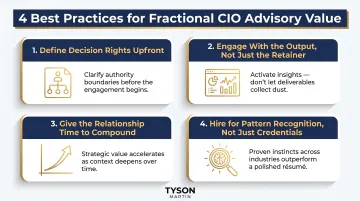
Four practices determine whether the engagement delivers or stalls:
- Define decision rights upfront. Establish who holds which decisions — board, executive committee, or functional owners. Document escalation thresholds: what constitutes a material incident requiring board involvement. A 90-day plan with named owners and measurable outcomes builds accountability from day one.
- Engage with the output, not just the retainer. Review dashboards. Act on escalations. Participate in briefings. Passive engagement wastes the retainer. When boards ask follow-up questions, challenge assumptions, and direct resources, fractional CIOs deliver sharper oversight.
- Give the relationship time to compound. Effectiveness grows as the fractional CIO builds institutional knowledge, calibrates risk thresholds to your specific environment, and earns trust with both the board and internal teams. Early recommendations are solid; later ones are precise.
- Hire for pattern recognition, not just credentials. Fractional CIOs who have lived through incidents, board scrutiny, and messy integrations spot the "small" gaps that cause big losses. Experience across large-scale cloud infrastructure, global security programs, or enterprise retail brings the judgment that prevents expensive missteps.
Conclusion
The importance of fractional CIO advisory lies in governance clarity, risk control, and the kind of consistent executive-level judgment that organizations cannot afford to leave to chance. Especially in regulated industries or during periods of transition, the cost of absent technology leadership—measured in budget overruns, audit findings, incident response failures, and board liability—far exceeds the cost of fractional engagement.
Those governance gaps don't stay static — they compound. A fractional CIO who establishes clear decision rights, stable reporting, and executable priorities doesn't just solve the immediate problem. They build a foundation that holds under pressure: boards get the oversight they need, executive teams gain clarity to act, and the organization moves forward with measurable risk reduction rather than institutional guesswork.
Fractional CIO advisory is an ongoing strategic practice, not a temporary fix. With 72% of CEOs planning to increase use of fractional executives within 12 months, adoption has accelerated well beyond early experimentation. For organizations navigating technology risk, regulatory pressure, or leadership transitions, fractional CIO advisory delivers the governance structure and executive accountability that boards require — without waiting for a full-time hire.
Frequently Asked Questions
What is fractional CIO service?
A fractional CIO is an experienced technology executive engaged on a part-time or contract basis to provide strategic IT leadership, technology governance, and cyber risk oversight. The role delivers the judgment and accountability of a full-time CIO without the permanent overhead or 9-13 month hiring and onboarding cycle.
How much does a fractional CIO cost?
Costs vary based on engagement scope, industry complexity, and experience level. Light engagements (1-2 days/week) range from $6,000-$10,000 monthly, while senior engagements (3+ days/week) reach $16,000-$22,000 monthly, representing 40-60% savings versus a full-time CIO. Most engagements require a minimum 3-month commitment to produce meaningful strategic outcomes.
When does a company need a fractional CIO rather than a full-time CIO?
Fractional CIOs fit when an organization has an IT team but lacks senior strategic leadership, during transition periods (M&A, executive departure, post-incident recovery), or when board-level technology oversight is needed without a permanent executive commitment. The model is built for organizations that need governance now, not in 9-13 months.
What is the difference between a fractional CIO and an IT consultant?
A fractional CIO operates as part of the leadership team—owning decisions, communicating to the board, and driving execution with clear accountability. A consultant typically delivers analysis or recommendations and exits, leaving implementation to internal staff. The fractional model embeds accountability for outcomes, not just advice.
Can a fractional CIO provide cybersecurity and technology risk oversight together?
Experienced fractional CIOs with cybersecurity backgrounds can cover both domains, aligning IT strategy with risk governance and ensuring cyber risk is reported at the board level rather than siloed within a technical team. This is especially valuable in regulated industries where technology and security decisions intersect with compliance obligations.
How quickly can a fractional CIO create value for a board or executive team?
A well-scoped fractional CIO engagement typically delivers visible governance improvements within 90 days: cleaner risk reporting, defined escalation paths, and an executable technology plan. Speed depends on executive sponsorship, clear decision rights, and board alignment on outcomes.