Hiring a full-time in-house CISO seems like the obvious solution. But the global talent shortage, six-figure compensation, and lengthy search timelines make it impractical for many organizations—especially those in transition, under regulatory pressure, or scaling quickly without existing security leadership.
This article delivers a clear comparison of both models across the dimensions that matter most to boards, CEOs, and risk leaders—so you can make a decision that fits your actual situation.
TLDR
- In-house CISOs provide deep organizational context and full-time accountability, but require $300K–$500K+ in total compensation, 6–12 month hiring timelines, and significant retention risk
- Fractional CISOs deliver immediate senior-level expertise and 60–80% cost savings, making them a strong fit for transitions, compliance deadlines, or building a security function from scratch
- The right choice depends on your organization's size, risk maturity, board reporting requirements, and whether you need strategic leadership now or are building toward a permanent hire
- Many organizations start with fractional leadership and hire in-house once the governance foundation is established
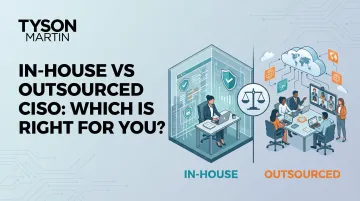
In-House vs. Outsourced CISO: Quick Comparison
| Dimension | In-House CISO | Fractional/Outsourced CISO |
|---|---|---|
| Cost | $300K–$500K+ annually (total comp with benefits); up to $1.6M+ at large enterprises with equity | $45K–$180K annually ($3,500–$15,000/month); approximately 20–40% of full-time cost |
| Time to Deploy | 6–12 months for search and hiring; 3–6 additional months for organizational ramp-up | Immediate to 2 weeks; can deliver board-ready reporting within 30 days |
| Board Reporting Quality | Strong after ramp-up period (6+ months); depth improves over time with organizational context | Immediate credibility with enterprise background; faster initial reporting, but may lack deep organizational nuance over time |
| Organizational Context | Deep immersion over time; learns business-specific risk profile, legacy architecture, and internal dynamics | Broad cross-industry pattern recognition; shallower organizational embedding but stronger benchmarking perspective |
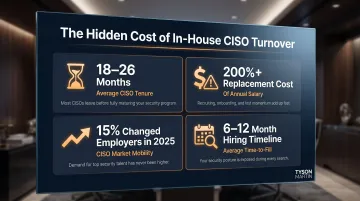
| Flexibility | Permanent structure; replacement cost exceeds 200% of annual salary; average tenure 18–26 months | Engagement can scale up/down; no replacement cost; serves as bridge to permanent hire or ongoing part-time leadership |
Not all outsourced CISO arrangements work the same way. The comparison above covers three related models — each suited to different situations:
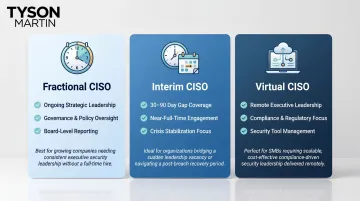
- **Fractional CISO**: Part-time strategic leadership on retainer, focused on ongoing governance and board reporting. Best for organizations that need executive-level security direction without a full-time headcount.
- **Interim CISO**: Temporary full-time or near-full-time coverage during leadership transitions, typically 30–90 days. Used when a gap needs to be filled fast without compromising continuity.
- Virtual CISO (vCISO): Remote executive leadership, generally more compliance-focused than strategic. Common in smaller or highly regulated organizations building baseline programs.
The hybrid model: Many organizations retain a fractional CISO to establish governance frameworks, define decision rights, and build board reporting structures. Once the program is mature, they hire a permanent leader into a well-defined role with measurable success criteria already set.
What Is an In-House CISO?
An in-house CISO is a full-time, permanent executive responsible for owning the organization's cybersecurity strategy, risk posture, program execution, and board-level reporting. This role sits within the organization's leadership structure with direct accountability to the CEO or board.
The core advantage is accumulated context. Over time, an in-house CISO learns the business's risk profile, legacy architecture, regulatory exposure, and internal politics — enabling more tailored decisions and stronger cross-functional relationships than any rotating advisor can develop.
Pros of an In-House CISO
Full-time availability and organizational accountability
An in-house CISO is always on—for incident response, leadership team decisions, regulatory inquiries, and board prep. There are no scheduling constraints or divided attention across other clients. This availability matters most during high-stakes moments: active breaches, audit deadlines, M&A diligence, or when the board needs immediate answers.
Long-term program ownership and institutional continuity
As the CISO builds institutional knowledge, they become a more effective operator. They develop security culture, build the team, sustain governance structures, and maintain relationships that outlast any single initiative. A CISO who stays three to five years delivers compounding returns in program maturity, team capability, and board credibility that no advisory rotation can match.
Cons of an In-House CISO
High total compensation and benefits overhead
The IANS/Artico 2025 CISO Compensation Survey puts median total CISO compensation at approximately $320K, with mid-market packages ranging from $300K–$500K. At large enterprises, Heidrick & Struggles' 2024 Global CISO Survey reports U.S. average total compensation of $1,648K — driven heavily by equity.
Stack in the full cost picture and first-year spend climbs quickly:
- Base + bonus + benefits: $300K–$500K for mid-market; $1M+ at enterprise with equity
- Benefits overhead: Add 25–30% on top of salary
- Recruiting fees: 20–30% of first-year compensation
- First-year all-in cost: Often $400K–$600K for mid-market hires
Hiring is slow and the talent pool is thin
The ISC2 2024 Cybersecurity Workforce Study reports a global cybersecurity workforce gap of 4.8 million professionals—a 19% year-over-year increase. The active global workforce held at just 5.5 million, with growth slowing to 0.1% compared to 8.7% the prior year.
CISO-level searches draw from an already depleted talent pool. Industry data indicates comprehensive executive searches typically take 20–24 weeks (5–6 months), with CISO searches frequently extending to 6–12 months in competitive markets or regulated industries. During this window, the organization operates without executive-level security leadership—a critical governance gap.
Ramp-up risk and early-tenure vulnerability
Even after hiring, a new in-house CISO typically spends three to six months learning the business before delivering credible board-level reporting or defensible risk decisions. Forbes Business Council research identifies the first 100 days as the "crucible" for long-term success — stakeholders form early judgments about the CISO's grasp of firm culture and strategic direction that are difficult to reverse.
Tenure instability makes this worse. Average CISO tenure sits at 18–26 months — well below other C-suite roles — and the IANS 2025 survey shows 15% of CISOs changed employers in 2025, up from 11% in 2024. CISOs also spend up to 20% of their first year on stakeholder relationship management alone. PA Consulting estimates replacement costs exceed 200% of annual salary when accounting for recruitment, interim coverage, onboarding, and lost productivity.
What Is a Fractional or Outsourced CISO?
A fractional CISO is a senior security executive who serves part-time or on a retainer basis—providing board-level governance, strategic direction, and executive accountability without the full-time employment structure.
Distinguishing the models:
- Fractional CISO: Ongoing part-time strategic leadership; establishes governance, owns board reporting, and leads the security function on a recurring engagement basis
- Interim CISO: Short-term gap coverage during leadership transitions; typically 30–90 days of focused stabilization work
- Virtual CISO (vCISO): Remote executive leadership; may focus more on compliance and tool management than strategic governance, though providers define the scope differently
This model has grown significantly. The global virtual CISO market is estimated at $1.2 billion in 2026, projected to reach $1.78 billion by 2035 at a 6.3% CAGR. For organizations that need senior leadership without the overhead, it's a deliberate governance strategy.
The WEF Global Cybersecurity Outlook 2026 reports that 85% of insufficiently resilient organizations lack the necessary workforce to achieve cybersecurity objectives, versus just 22% of highly resilient organizations. Fractional models help close this gap.
Pros of a Fractional or Outsourced CISO
Immediate Senior-Level Credibility
A fractional CISO with enterprise background can step in, assess the risk posture, establish clear board reporting, and deliver a 90-day plan within weeks of engagement. They bring pattern recognition from real incidents, board scrutiny, and complex integrations—across multiple client environments. A new hire needs months to build that context. A seasoned fractional CISO identifies critical gaps before they become major losses.
Cost Efficiency Without Sacrificing Governance
According to Breach Craft's 2026 analysis, vCISO engagements typically range from $3,500–$15,000 per month ($45K–$180K annually)—approximately 20–40% of the total cost of a full-time CISO. This makes executive-grade leadership viable for mid-market, regulated, or transitioning organizations at operating-budget cost rather than headcount expense.
Organizations avoid recruitment fees, benefits overhead, equity grants, and the 200%+ replacement cost when tenure ends early.
Executive-Level Governance in Practice
Tyson Martin's fractional CISO model illustrates what board-ready governance looks like without full-time employment. His engagements deliver:
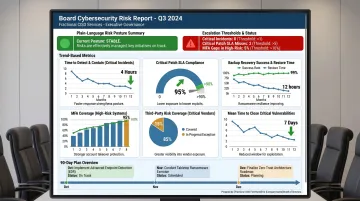
- Plain-language risk posture and what changed since last briefing
- Stable dashboards showing trend, not trivia
- Clear decision rights and escalation thresholds that hold during real incidents
- 90-day plans with owners and measurable outcomes
- Board reporting in business terms—money, downtime, legal exposure, trust—not technical tool terminology
This approach addresses a critical board-level need: defensible oversight that connects security work to business goals, documents risk acceptance plainly, and ensures follow-ups replace vague commitments.
Cons of a Fractional or Outsourced CISO
Limited Availability and Divided Attention
A fractional CISO is not on-call 24/7 and may serve multiple clients simultaneously. Organizations with high-frequency security decisions, active incidents requiring daily coordination, or large internal teams to manage may find part-time engagement insufficient.
For crisis situations like active breach response, interim CISO services (near-full-time coverage) or in-house leadership may be more appropriate than fractional engagement.
Shallower Organizational Immersion Over Time
Informal signals—cultural dynamics, operational friction, shifting business priorities—tend to surface through daily presence. Without it, a fractional CISO may miss context that shapes the quality of risk recommendations.
The trade-off: fractional CISOs bring broader cross-industry benchmarking perspective and pattern recognition, but sacrifice the institutional knowledge that compounds over years of full-time tenure.
In-House vs. Outsourced CISO: Which One Fits Your Organization?
The right choice depends on five factors: organization size and security function complexity, existing governance maturity, board reporting requirements, regulatory environment, and whether you're in a steady state or active transition.
Situational Guidance
Choose an in-house CISO if:
- Your organization is large enough to require full-time security leadership—typically 500+ employees or $100M+ revenue with distributed IT infrastructure
- You have budget for competitive total compensation ($300K–$500K+) and can sustain retention through equity, career development, and executive positioning
- You're in a stable operating phase where deep organizational immersion will compound in value over years
- You have at least a basic security program that a new CISO can build on rather than start from scratch
- Your board requires dedicated executive accountability at all times, including 24/7 incident availability
Choose a fractional or outsourced CISO if:
- You need senior security leadership now but cannot afford the 6–12 month hiring timeline or $300K–$500K+ annual cost
- You're navigating transition: M&A activity, compliance deadlines, recent security incidents, new regulatory requirements, or leadership turnover
- You're standing up a security function from scratch and need governance structure before hiring a permanent leader
- You need board-ready reporting and defensible risk posture immediately, not in six months after a new hire ramps up
- You want to validate the scope and structure of a permanent CISO role before committing to a full-time hire
Use the hybrid or interim model during:
- Leadership transitions when an in-house CISO departs and you need governance continuity during the search
- Independent security assessments when a new CEO or board wants objective risk evaluation
- Entry into regulated environments for the first time (HIPAA, SOC 2, CMMC, FedRAMP)
- M&A diligence and integration when cyber risk could impact deal valuation or post-close operations
The Board Governance Lens
Regardless of which model you choose, the CISO's primary output for boards and audit committees should be the same:
- Plain-language risk posture showing what changed since last briefing
- Trend-based metrics (not tool counts or ticket volume)
- Clear decision rights: what requires board input versus management delegation
- Defensible escalation thresholds for incidents and disclosure obligations
Model selection should be evaluated by which option delivers this output most reliably for your organization's current stage. That standard doesn't change with employment structure. Under SEC cybersecurity disclosure rules (effective December 2023), public companies must describe board oversight of cybersecurity risks and management's expertise. The regulation doesn't specify how the CISO role is structured: what matters is that the function exists, has board access, and produces defensible reporting.
Decision Checklist
Use these questions to pressure-test your decision:
| Question | What It Signals |
|---|---|
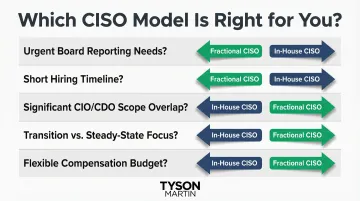
| Do you have a board-level security reporting requirement today? | If yes and no CISO is in place, fractional is faster. |
| Can you sustain a 6–12 month hiring timeline? | If no, fractional eliminates search risk immediately. |
| Does your CISO need to cover CIO or CDO scope? | If yes, that points toward in-house or a hybrid model. |
| Is this a transitional or steady-state moment? | Transition favors fractional; steady-state with a long-term vision favors in-house. |
| Do you have budget for $300K–$500K+ in total compensation? | If no, fractional delivers executive leadership at $45K–$180K annually. |
Conclusion
Neither model is universally superior. The right CISO structure is the one that delivers clear oversight, credible reporting, and defensible decisions at the governance level your organization actually requires — right now, not eventually.
If your organization is navigating a leadership gap, board scrutiny, compliance pressure, or a security function that lacks executive ownership, an experienced fractional or interim CISO can close that gap quickly — with the governance structure and accountability your board is already asking for.
Tyson Martin has led security governance at AWS, Home Depot, and Best Buy, and contributes actively to NACD and the NRF CISO Executive Committee. His fractional CISO engagements deliver:
- Board-ready risk reporting in plain language
- Clear decision rights and escalation thresholds
- Stable dashboards that show trend, not noise
- Executable 90-day plans with owners and measurable outcomes
Connect with Tyson Martin at tyson.martin@gmail.com or +1 (802) 430-9200 to discuss your organization's needs.
Frequently Asked Questions
Which is better, outsourcing or insourcing a CISO?
Neither is universally better. Outsourcing wins on speed and cost efficiency for organizations in transition or without existing security leadership. Insourcing wins on depth and continuity for large, mature programs. The right answer depends on your organization's current governance moment and whether you need immediate executive leadership or long-term institutional ownership.
What does a fractional CISO do?
A fractional CISO provides executive-level cybersecurity leadership on a part-time or retainer basis: setting strategy, owning board reporting, establishing decision rights, and leading the security function without a full-time employment structure. They deliver governance outcomes and measurable progress within defined engagement windows.
How much does an in-house CISO cost compared to a fractional CISO?
In-house CISOs cost $300K–$500K+ annually in total compensation (salary, bonus, benefits) for mid-market organizations, and can exceed $1.6M at large enterprises when equity is included. Fractional CISOs cost $45K–$180K annually ($3,500–$15,000/month), roughly 20–40% of the full-time cost. Cost matters, but so does availability, organizational context, and governance maturity.
When should a company hire a full-time CISO instead of outsourcing?
Hire a full-time CISO when the security function requires dedicated daily leadership and the organization is in a stable operating phase. Budget must support competitive compensation, and the board should require executive accountability at all times, including 24/7 incident availability.
Can an outsourced CISO credibly represent the organization to the board?
Yes. A senior fractional CISO with board-level experience can deliver credible risk reporting, own escalation thresholds, and present to audit and risk committees. In many cases, they outperform an early-tenure in-house hire still learning the business. Governance credibility depends on experience, communication clarity, and ability to connect risk to business outcomes, not employment structure.
What is the difference between a fractional CISO, an interim CISO, and a virtual CISO?
Fractional CISOs serve ongoing part-time in a strategic leadership role, providing governance and board reporting on retainer. Interim CISOs fill a temporary gap during leadership transitions, typically working near-full-time for 30–90 days. Virtual CISOs (vCISOs) often work remotely and may focus more on compliance and tool management. Definitions vary by provider, so evaluate the specific engagement scope rather than relying on the title.