What does a cybersecurity assessment for financial institutions typically include?
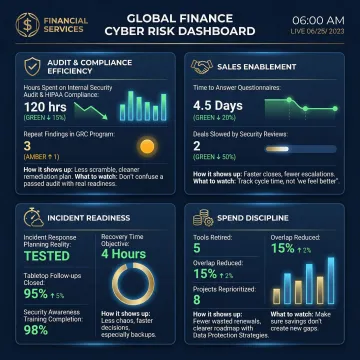
A comprehensive assessment evaluates your cybersecurity program maturity, control effectiveness, and regulatory alignment. We review technical controls, governance frameworks, incident response capabilities, third-party risks, and data protection measures. Deliverables include board-ready metrics showing current state, gap analysis with prioritized remediation roadmaps, ownership assignments, and trend tracking. The assessment identifies your top risks, quantifies potential business impacts, validates recovery capabilities, and ensures your security investments align with regulatory expectations and business objectives.
How long does a typical cybersecurity assessment take?
Assessment timelines depend on organizational complexity and scope. A focused program assessment typically takes 2-4 weeks from kickoff to final reporting, including stakeholder interviews, documentation review, technical evaluation, and deliverable preparation. More comprehensive assessments covering multiple domains—such as third-party risk, incident readiness, and application portfolios—may extend to 6-8 weeks. We establish clear milestones upfront with 30-60-90 day deliverable schedules, ensuring you receive actionable insights quickly while maintaining thoroughness. Rush assessments for regulatory deadlines or incident response can be accelerated.
Will this assessment disrupt our daily operations?
No. Our assessment methodology minimizes operational impact through efficient interview scheduling, non-intrusive documentation reviews, and passive technical evaluations. We coordinate with your teams to work around critical business periods and system maintenance windows. Most data gathering occurs through existing reports, configuration reviews, and stakeholder discussions rather than active scanning or testing. You'll maintain full operational continuity while we build a comprehensive risk picture. Any testing components—such as backup validation or tabletop exercises—are scheduled collaboratively to ensure minimal disruption.
How do you ensure assessment findings remain confidential?
Assessment confidentiality is paramount. All findings, documentation, and communications are protected under strict confidentiality agreements and professional standards. We limit report distribution to designated stakeholders only, use secure channels for all data transmission, and maintain separation between client engagements. Technical findings, organizational details, and risk profiles never leave the engagement boundary. Final deliverables are provided in controlled formats with clear handling instructions. Our background includes managing sensitive information at Fortune 100 organizations and regulated enterprises—confidentiality and discretion are fundamental to every engagement.
What makes financial institution assessments different from general cybersecurity assessments?
Financial institution assessments must address heightened regulatory scrutiny, examiner expectations, and sector-specific threat landscapes. We incorporate FFIEC guidance, state and federal banking regulations, and industry frameworks like NIST CSF with financial services overlays. Assessments evaluate controls through the lens of regulatory compliance, third-party risk concentration, customer data protection, and business continuity requirements specific to financial operations. Our approach recognizes that financial institutions face sophisticated adversaries, complex vendor ecosystems, and zero tolerance for customer data breaches—requiring deeper rigor in vendor oversight, incident readiness, and board reporting.
How do assessment results support board reporting and governance?
Assessment deliverables are designed for board consumption—translating technical findings into business impacts, decision points, and risk trade-offs. Reports include one-page executive summaries showing top risks, trend comparisons, and measurable progress against prior periods. We identify decision rights, escalation thresholds, and governance gaps that could impede incident response or regulatory compliance. Findings include clear ownership assignments, remediation timelines, and KPIs that boards can monitor over time. The format enables audit committees and risk committees to fulfill oversight duties with confidence, armed with defensible data and actionable priorities.
Can you help us prepare for regulatory examinations?
Yes. Our assessments identify gaps that examiners typically flag—including control deficiencies, documentation weaknesses, vendor oversight shortfalls, and governance lapses. We provide remediation roadmaps with clear ownership and realistic timelines that demonstrate commitment to continuous improvement. Deliverables include evidence packages that support examination responses, showing documented controls, testing results, and management oversight. We help you frame cybersecurity investments in terms examiners understand—risk reduction, compliance alignment, and board engagement. This preparation reduces examination friction, accelerates closure of findings, and demonstrates mature risk management to regulators.
What happens after the assessment is complete?
Post-assessment, you receive comprehensive deliverables including executive summaries, detailed findings, prioritized remediation roadmaps, and ongoing monitoring recommendations. We conduct a presentation to key stakeholders—typically board committees, executive leadership, and technical teams—to review findings, answer questions, and align on next steps. Many clients engage us for implementation support, fractional CISO services, or ongoing advisory to execute the roadmap. We provide measurement frameworks so you can track progress, demonstrate risk reduction, and update boards with stable metrics. Follow-up assessments validate improvements and show trend data over time.